


Greek salad is the one I’d put next to lamb most often, and I mean horiatiki, the version with no lettuce. Tabbouleh, fattoush and plain chopped cucumber and tomato come right behind it. Lamb is rich and strongly scented, and these salads answer with acid and fresh herbs, or just crunch.
Lamb’s smell can actually be measured. A 2014 Meat Science study of 178 fat samples found that two branched-chain fatty acids moved consumers’ smell scores for grilled lamb. None of the five compounds tested changed how much people liked the flavor.
Which salads go best with lamb?

Greek salad is the safest pick for most lamb dinners, with tabbouleh, fattoush and chopped cucumber and tomato salads close behind. Grain salads handle heavier roasts, and leafy or fruit salads suit lighter cuts.
The order below follows how many lamb dishes each salad works with, not how good it is on its own.
Greek salad (horiatiki)

Horiatiki means village salad, and the traditional version has no lettuce. You get chunked tomato, cucumber, green pepper and red onion, plus olives, a slab of feta, oregano and olive oil.
Recipes disagree on acid. Some rely on tomato juice and oil alone, others add a splash of red wine vinegar. Next to lamb, add the splash.
Nothing in it wilts, and the feta and olives bring salt and tang. The catch is the tomatoes, which need to be ripe summer ones, so it’s a poor choice in February. It also suits lemon-and-oregano lamb better than harissa or cumin lamb. For those, tabbouleh or a yogurt salad does more.
Tabbouleh

Parsley is the main ingredient. Mint, tomato, lemon and a small amount of fine bulgur make up the rest.
All that herb plus the lemon cuts through spiced lamb cleanly. Bulgur-heavy versions go soggy fast, though.
Chef Yotam Ottolenghi argues tabbouleh is all about the parsley, as Milk Street noted in 2017. Milk Street also found that US versions lean on bulgur, which soaks up tomato juice and turns mealy.
Milk Street’s fix is to barely hydrate the bulgur and dry the herbs thoroughly, because wet herbs dilute the dressing.
Fattoush

Levantine fattoush piles herbs and vegetables under crisp pita, dressed with lemon and mint and often sumac. Grilled lamb chops and shawarma plates are where it fits most naturally.
It does its job when the lamb is grilled or spit-roasted and the salad gets dressed at the last minute. Let it sit dressed for a while and the pita goes soft, and the crunch that justified the salad is gone.
Cucumber and tomato salads

Israeli salad is the finely diced version, dressed with lemon and olive oil. Cucumber and chickpea with a feta-mint vinaigrette sits nearby, and so does cucumber with yogurt and dill.
They’re cold, sharp and need no cooking at all. Cucumber releases water once salted, so dress them close to serving or you end up with a watery bowl.
Grain-based salads
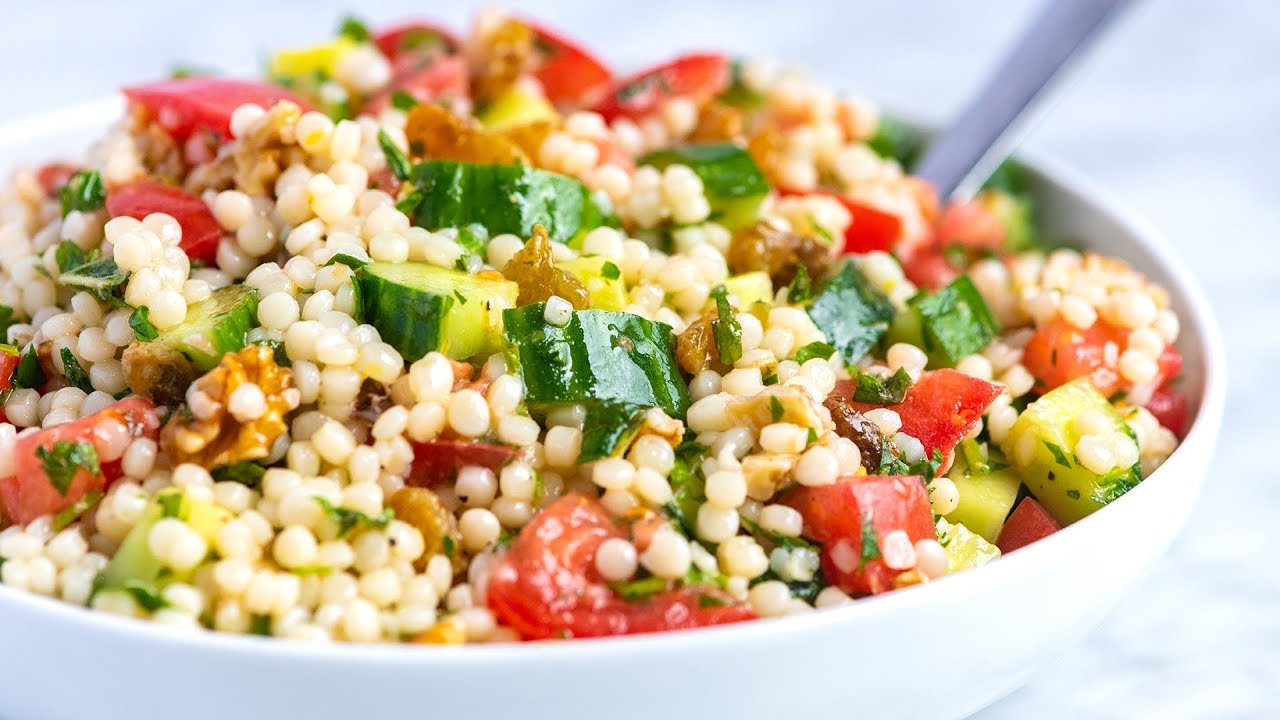
Grain salads replace the starch on the plate, so they work where roast potatoes or rice would otherwise go.
| Base | What it is | Character in a lamb salad |
|---|---|---|
| Couscous | Steamed semolina | Soft, soaks up lamb juices |
| Bulgur | Cracked wheat | Chewy, nutty |
| Fregola | Toasted Sardinian pasta | Chewy bite, toasted flavor |
| Freekeh | Roasted young green wheat | Smoky, firm |
A bowl of any of these is filling enough to be the only side. Soft grains next to slow-cooked shoulder can leave you with a plate that has one texture, so fold in raw herbs or crisp vegetables.
Leafy and fruit salads

Lighter cuts such as rack and chops take these best.
- Rocket and shaved fennel with lemon give a peppery, aniseed crunch
- Beet, carrot and pomegranate is sweet-tart and good with medium-rare lamb
- Watermelon and feta, sweet and salty, suits a summer grill
Delicate leaves wilt under hot jus, so keep the dressing off until the plate is built.
What makes a salad balance lamb’s richness?
Acid does most of the work. Lemon or vinegar cuts through the fat, while mint and parsley lift the aroma. Raw, crunchy vegetables reset the palate between bites.
On the acid side there’s lemon juice, red wine vinegar, sumac and pomegranate molasses. Herbs run to mint, flat-leaf parsley, dill and oregano. Rocket, fennel, radish and cucumber bring bitterness and crunch, and pomegranate seeds, apple, feta and olives add the sweet-tart and salty accents.
Mint is the herb most cooks reach for first with lamb. For other pairings, a herb pairing chart is a quick check.
Roast potatoes and mash do none of this. They add starch and more fat, with no acid to offset either.
Is it the fat or the aroma that needs balancing?
Studies disagree on what drives lamb’s strong smell.
Watkins and colleagues (Meat Science, 2014) analyzed 178 fat samples from Australia’s Information Nucleus Flock. Two branched-chain fatty acids, 4-methyloctanoic and 4-ethyloctanoic acid, affected consumers’ “like smell” scores for grilled lamb, while none of the compounds changed how much they liked the flavor.
A German study of 98 lamb chops (Schiller et al., Archives Animal Breeding, 2015) measured three such acids: 4-methyloctanoic, 4-ethyloctanoic and 4-methylnonanoic. It found no significant correlation with sensory traits, and the authors suggest the concentrations were too low or that other compounds are involved.
The samples differ in breed, size and rearing system, so the two results do not contradict outright.
For the cook, the chemistry stays unsettled. Acid, herbs and crunch work on the plate either way, which is why the pairing rule rests on kitchen practice, not on one compound.
How do you match the salad to the lamb dish?

Match the salad’s weight to the cut. Soft, slow-cooked meat needs a sharp, crunchy salad, quick-cooked prime cuts take a lighter one, and spiced minced lamb needs something cooling.
| Lamb dish | Best salad | Dressing | Serve |
|---|---|---|---|
| Roast leg | Greek salad, or tomato, cucumber and feta | Lemon and olive oil | Cold |
| Slow-cooked shoulder | Shaved fennel and rocket | Lemon or pomegranate molasses | Cold |
| Chops and rack | Beet and carrot, or a leafy salad | Lemon vinaigrette | Cold or room temperature |
| Kofta | Tabbouleh, or cucumber with yogurt | Lemon or yogurt | Cold |
| Shawarma | Fattoush | Lemon, mint, sumac | Cold |
Two sources point to the same rule when read together. Meat & Livestock Australia’s Meat Standards Australia guidance recommends grilling for leg cuts, loin and topside, and roasting for leg cuts, rack and shoulder. Teys Australia adds that shoulder is the most economical cut and needs long, slow, moist cooking to tenderize it.
Long-cooked cuts end up soft, so the salad has to supply the crunch. Quick-cooked cuts stay firm and pink, which lets the salad stay delicate.
The rub changes the answer too.
Rosemary and garlic lamb takes a Greek salad or a lemon-herb salad happily. Harissa or cumin lamb wants something cooling instead, such as tabbouleh or cucumber with yogurt.
At the spiced end sit kofta and the spit-roasted meat known as shawarma. Both pair better with cold, acidic salads than with anything creamy.
For a roast leg, count back from carving time with a roast timer so the salad is dressed while the meat rests. USDA FSIS sets lamb steaks, chops and roasts at 145 degrees Fahrenheit (62.8 degrees Celsius) with at least 3 minutes of rest (chart updated April 2025).
That is barely enough time to toss a salad for chops. A leg rests longer, and one roast leg recipe from Williams Sonoma leaves it 15 minutes.
Which dressing suits lamb best?
Lemon vinaigrette is the default. Yogurt dressings suit spiced lamb, tahini suits roasted vegetable and grain salads, and pomegranate molasses or sumac adds sweet-sour lift to herb and leafy salads.
How much acid belongs in a lamb vinaigrette?
Sources disagree on the base ratio of oil to acid.
The culinary textbook Professional Cooking by Wayne Gisslen gives 3 to 1 as the classic formula. America’s Test Kitchen calls 4 to 1 the “usual” ratio in its 2007 wilted spinach salad recipe. The Kitchn argues for 1 to 1, saying it makes a brighter, more flavorful dressing.
Lamb already supplies the fat, so lean toward the acid end. Start at 2 to 1, taste the dressing against a bite of meat, and add lemon until the fat stops coating the tongue.
Scaling a dressing by eye for a crowd is where ratios drift. A recipe converter keeps the proportions when you double or triple.
Yogurt and tahini dressings
Yogurt is cool, tangy and thick, usually with mint or dill, and it’s the best partner for harissa, cumin or chilli-spiced lamb.
Tahini is sesame paste thinned with lemon juice and water. It belongs on roasted vegetable and grain salads, such as a curry-roasted fennel salad with rosemary tahini dressing.
Neither belongs on a delicate leaf salad. Both weigh the leaves down.
Pomegranate molasses and sumac
America’s Test Kitchen describes pomegranate molasses as reduced pomegranate juice, a syrup that layers astringent, floral and faintly bitter notes over a sweet-tart base. It is a pantry staple across the eastern Mediterranean.
Whisk a spoonful into a lemon vinaigrette for beet and carrot salads or fattoush. Sumac is the dry option. It’s tart and lemony, with no extra liquid to thin the dressing.
Mint goes in the dressing or in a sauce, not both. Blend it into the vinaigrette or serve mint sauce on the meat, and the plate stays balanced.
How do temperature, season and make-ahead timing change the pick?
Serve leafy and herb salads cold, and roasted vegetable, lentil and grain salads warm or at room temperature. Spring and summer menus favor raw, crisp salads, winter roasts favor roasted ones, and grain salads are the ones to make ahead.
Cold or warm

Cucumber and tomato salads, tabbouleh, fattoush and leafy salads all go cold. They offset hot, fatty lamb by contrast.
Roasted fennel, cauliflower with pomegranate and apple, and sweet potato with lentils and rocket are better warm or at room temperature. Sturdy ingredients like these keep their texture beside hot meat.
The heavier the lamb, the colder and sharper the salad. A slow-roasted shoulder in January is the exception, because a warm roasted salad keeps the plate coherent.
Season and occasion
FSIS limits the label “spring lamb” to new-crop lambs slaughtered from March through the close of the week containing the first Monday in October (9 CFR 317.8(b)(4)). A summer barbecue can carry that label as legitimately as Easter dinner.
- Easter and spring menus suit shaved vegetable, pea and herb salads
- For a summer barbecue, go with cucumber and tomato, tabbouleh or watermelon and feta
- Winter roasts want roasted vegetable and lentil salads
- On a weeknight with chops, a leafy or cucumber salad that needs no cooking is plenty
Outdoor serving runs on a clock. FSIS says perishable food should not sit out more than 2 hours, or 1 hour when the air is above 90 degrees Fahrenheit (32 degrees Celsius).
Feta, yogurt and cooked grain salads all qualify, so set the bowl inside a larger bowl of ice.
Make-ahead timing
| Salad type | Prepare ahead | Finish at serving |
|---|---|---|
| Grain and bean salads | Cook, cool, dress | Fresh herbs, lemon |
| Cucumber and tomato | Chop, hold undressed | Salt, dress |
| Leafy and fruit | Wash, dry, mix dressing | Toss |
| Fattoush | Chop vegetables, mix dressing | Add pita, toss |
Ina Garten’s method, as Food Republic reported it, puts the dressing in the bottom of the bowl, lays the greens on top and tosses at the last moment. Food Republic extends the idea to jar salads. Hardy vegetables go directly on the dressing, then grains, legumes and watery vegetables, with delicate greens and crunchy toppings last. Carrots and kale can sit in acid for a few hours, while rocket cannot.
Cooked grains run on a separate clock. Consumer Reports, citing FSIS, says cooked rice, other grains and pasta should be refrigerated within 2 hours. FSIS’s general rule shortens that to 1 hour when the air is above 90 degrees Fahrenheit, and FSIS limits refrigerated leftovers to 3 to 4 days.
When does a salad not suit lamb?
A salad fails beside lamb when it is creamy, when it’s sweet against heavily spiced meat, or when it was dressed too early. It also fails when the season calls for a hot, starchy plate.
| Wrong fit | Why it fails | Swap |
|---|---|---|
| Mayonnaise-based slaw or potato salad | Fat on fat, no acid | Cucumber and tomato with lemon |
| Sweet fruit salad with harissa or cumin lamb | Sugar competes with spice | Tabbouleh or fattoush |
| Leafy salad dressed an hour early | Acid and salt soften the leaves | Dress at serving |
| Cold salad beside a winter braise | Half-cold plate | Warm roasted vegetable salad |
Roundups disagree on fruit. Lists from PureWow and others pair lamb with cantaloupe, fig and strawberry salads, while Middle Eastern recipes lean on sumac, pomegranate and herbs.
Both camps work with plain roast lamb seasoned with rosemary and garlic. The clash appears against harissa and cumin.
Wilting is not always a failure. America’s Test Kitchen’s spinach salad with feta, olives and lemon vinaigrette wilts the leaves on purpose with warm dressing, using just 1/4 cup for 6 cups of greens (2007).
That is the exception to dressing at the last second, and it only works when the salad is built to wilt.
One salad and one starch is enough for most lamb dinners. A second sharp salad competes with the first, and a third dish adds nothing.
Salad with Lamb FAQ
Which sauce goes with lamb besides mint sauce?
Tzatziki is the usual alternative. It’s a cool mix of yogurt, cucumber and garlic that suits grilled and spiced lamb. Chimichurri and salsa verde work on chops.
Sauce goes on the meat and dressing goes on the salad, so keep one sharp element on each.
What other sides go with lamb besides salad?
Starches lead, whether that’s roast potatoes, rice, pita or couscous, which soaks up the lamb juices. Greek-style lamb takes lemon potatoes.
Roasted carrots and minted peas fill the vegetable slot.
Can leftover lamb go into the salad itself?
Yes. Slice or shred roast lamb over leaves, feta and a sharp dressing, or fry it in a cornflour coating until crisp first.
If you serve it warm, USDA FSIS puts the reheating target for leftovers at 165 degrees Fahrenheit (73.9 degrees Celsius).
Are there gluten-free salads that go with lamb?

Yes. Greek salad and chopped cucumber and tomato salads contain no gluten.
Tabbouleh (bulgur), couscous salads and fattoush (pita) do contain wheat. Swap quinoa for bulgur, or leave the pita out.
Timing the salad and the lamb on the day
A salad with lamb arrives on time when every component is prepped before the meat leaves the heat, and only the tossing waits for the rest. That rest is the single window for the final step.
Start with the grains, since cooling can’t be hurried. Chop the vegetables and mix the dressing while the grains cool, and save the leaves, pita and herbs for the very end. Dressed leaves tolerate no wait at all.
Chops rest for at least 3 minutes, enough to toss a leafy salad but not to cool a pot of couscous. A grain salad therefore has to be finished before the lamb goes on.
The trade-off is a final chore at the table, and a salad that cannot be fully assembled in advance.
I checked this sequence against FSIS guidance in October 2026 (chart last updated April 2025). A longer mandated rest would widen the window for dressing.


