

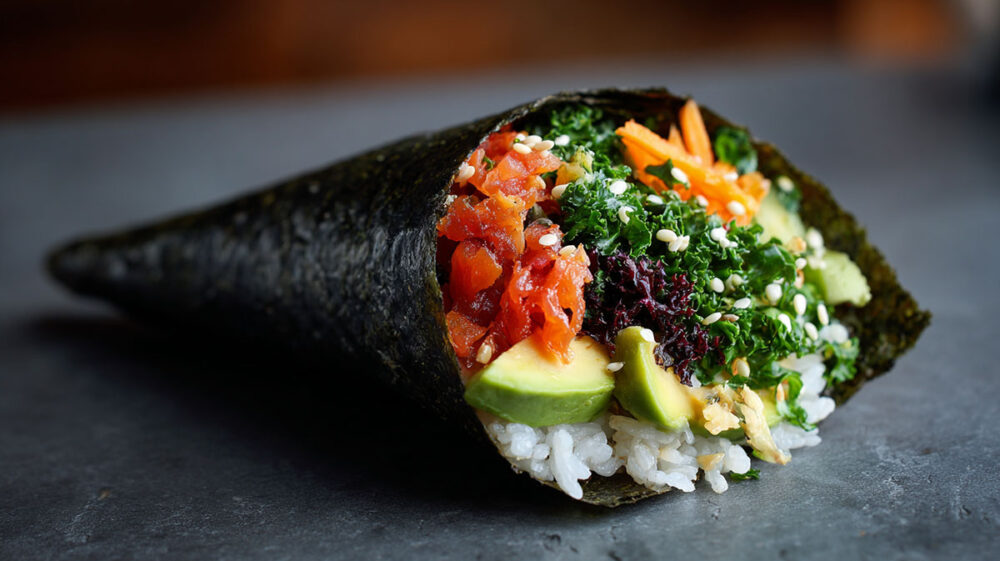
Temaki is what Japanese cooks call it, and the idea is simple: one sheet of nori, a handful of seasoned rice, some filling, and a cone shaped in your palm. There’s no bamboo mat and no cutting. You eat it within moments of assembly.
In Japanese homes it shows up at parties where guests build their own. At restaurant counters, a chef rolls each cone and hands it over the second it’s finished.
The English term is newer than the food. Merriam-Webster dates its first known use to 1981.
What Is Hand Roll Sushi?

Seasoned rice and fillings go onto a single sheet of nori, and the whole thing gets shaped by hand into an open cone. No bamboo mat, no knife. You eat it with your hands right after it’s put together.
What temaki means
Translated literally it’s “hand roll”, with te for hand and maki for roll. Menus sometimes print it as temaki-zushi.
Merriam-Webster dates the first known use of “hand roll” to 1981, which is later than most people would guess.
Most definitions include rice, and Merriam-Webster describes the filling as typically sushi rice with seafood or vegetables. A few sources describe rice-free cones where raw fish carries the roll. Vinegared rice is what defines sushi as a whole, so a cone without it sits at the edge of the definition.
Shape and size
The wide opening sits at the top, so the fillings stay visible. A hand roll uses half a nori sheet, small enough to hold in one hand, and one roll counts as one serving, eaten whole.
There’s nothing to slice or pass around. MasterClass likens eating one to eating an ice cream cone.
Where hand rolls come from
Sources disagree on when the cone appeared.
The Takeout places temaki in the late Edo period (19th century) as a quick, cheap street food, and Food Republic reports the same Edo origin as one theory among several. The Forked Spoon goes the other way, calling it a relatively recent addition that is unlikely to be found on menus before the 20th century.
The Nibble leans toward the late Edo period but admits that precise dates have not been determined. The split seems to come down to what each source is tracing. The Edo accounts follow rolled sushi in general, while the later date applies to the open cone itself.
Either way, the longer history of sushi supplies the Edo-period backdrop.
Nori, Rice and Condiments in a Hand Roll
A hand roll comes down to a nori wrapper, seasoned rice and a filling. Soy sauce, wasabi and pickled ginger go alongside.
Nori is toasted seaweed, cut to half a standard sheet for a hand roll. Crispness is the whole point of temaki, and the sheet starts to soften once damp rice and fillings sit against it.
The rice is shari, short-grain Japanese rice (uruchimai) that’s steamed and then seasoned with rice vinegar, sugar and salt while still warm. Norecipes says its high amylopectin content is what makes it sticky enough to hold the cone. Serve it at room temperature, neither steaming nor chilled.
Soy sauce, wasabi and gari (pickled ginger) finish the plate. Gari is eaten between rolls to reset the palate, not piled on top of them.
The set mirrors the ingredients that go into sushi in general. A hand roll just skips the mat and the knife.
The vinegar does more than add tang. It also acidifies the rice, and regulators disagree on how far that has to go.
| Jurisdiction | pH limit | What it allows |
|---|---|---|
| Orange County, California (2022) | below 4.6 | Rice classed as non-TCS food |
| Kentucky (guidance built on the 2013 FDA Food Code) | below 4.2 | Rice held at room temperature |
These limits apply to businesses that hold rice for hours, not to a batch made for one dinner. If you’re holding rice longer than that, the stricter number is the safer pick.
Common Hand Roll Fillings and the Raw Fish Safety Rules
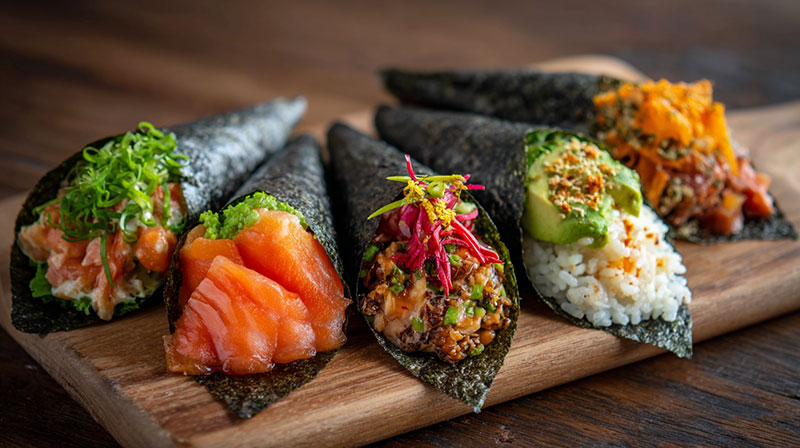
Raw fillings include spicy tuna, salmon and negitoro (minced fatty tuna with scallion). On the cooked side you get shrimp tempura, crab and grilled eel, and cucumber and avocado cover the vegetables.
Raw fish fillings
Raw fillings get the most scrutiny. The FDA’s Hazards and Controls Guidance says brining and pickling reduce the parasite hazard in fish but do not eliminate it.
Certain wild-caught species carry a parasite risk in sushi fish, and freezing is the control the FDA names for fish served raw. For fish intended for raw consumption, any one of these conditions works:
- -4 degrees F (-20 degrees C) or below for 7 days total
- -31 degrees F (-35 degrees C) or below until solid, then held at -31 degrees F or below for 15 hours
- -31 degrees F or below until solid, then held at -4 degrees F or below for 24 hours
The source is the FDA’s Fish and Fishery Products Hazards and Controls Guidance, Chapter 5 (Fourth Edition, June 2022 edition), and the same three conditions are listed in Food Code section 3-402.11.
There are exceptions. The Food Code exempts certain Thunnus tuna species (yellowfin among them), molluscan shellfish, fish eggs removed from the skein and rinsed, and farm-raised fish fed formulated feed, backed by a supplier statement kept on file.
That’s why the same rule treats a tuna filling and a wild salmon filling differently.
The Food Code binds restaurants and retailers. At home, ask the fishmonger whether the fish was frozen to one of these conditions.
Cooked and vegetable fillings
The Forked Spoon observes that hand rolls typically use fewer raw or uncooked ingredients than cut sushi rolls. Common cooked picks are shrimp tempura, hot-smoked salmon and California-style crab with avocado, with cucumber for something plain.
Cold-smoked salmon is not cooked, so treat it like a raw filling.
Grilled unagi eel is fully cooked, so the freezing rules above don’t apply to it. Heating fish enough to kill bacterial pathogens also kills parasites, according to the FDA guidance.
A cucumber and avocado roll is the vegetarian default, and it needs no safety paperwork at all. Honestly, it’s a perfectly good roll on its own, not just a beginner option.
How to Make Hand Roll Sushi Without a Bamboo Mat

Halve a nori sheet, press a thin layer of rice onto one side, lay the filling on top, then fold one corner over it and roll the rest into a cone. A hand roll needs no mat, no knife and no rolling technique, only a bowl of rice and your hands.
- Prepare everything first: rice at room temperature, fillings cut into thin strips, nori halved.
- Lay the half sheet flat in your palm.
- Press a thin layer of rice onto the left side of the sheet.
- Place the filling on the rice, then fold the bottom-left corner over it toward the middle of the top edge and hold it with your thumb.
- Roll the rest of the nori around that fold into a cone, keeping the wide opening at the top.
- Seal the free edge with a grain of rice and eat the roll immediately.
Don’t pre-roll. A cone left sitting on a plate ends up with soft nori.
Overfilling is the usual mistake. Thick fillings make the cone floppy or stop it from closing, so cut strips thin. Rolling ahead or adding wet fillings softens the sheet too, so roll one at a time. And if the first fold is weak, the cone unravels in your hand, which is why you pin it with your thumb until the roll is sealed.
How Does Hand Roll Sushi Differ From Maki and Nigiri?
Maki is rolled in a bamboo mat (makisu) and sliced into 6 to 8 pieces, according to MasterClass, while a hand roll is shaped in the palm and left whole. Uramaki flips things so the nori sits inside, and nigiri leaves nori out altogether.
| Style | Nori | Shaping | Served as |
|---|---|---|---|
| Hand roll | Outside, half sheet | By hand into a cone | One whole roll |
| Maki | Outside, half to full sheet | Bamboo mat, then cut | 6 to 8 pieces |
| Uramaki | Inside, rice outside | Bamboo mat, then cut | Sliced pieces |
| Nigiri | None | Pressed by hand | Single mound with topping |
Hosomaki and futomaki are both mat-rolled maki sushi with the nori outside. Per MasterClass, hosomaki holds a single filling and futomaki several, and the nori is sized to match, from a half sheet to a whole one.
Uramaki puts the rice outside and the nori inside, hence the name, which translates as “reverse roll.” It’s more common outside Japan, and Bite My Bun calls it an American invention. The California roll is the usual example.
Nigiri skips the nori altogether. A piece of nigiri sushi is a small oblong mound of vinegared rice with fish or another topping laid across it, and like a hand roll it gets eaten by hand.
Sources split on whether a hand roll counts as maki at all.
MasterClass calls hand rolls and sushi rolls both types of maki sushi, and Just One Cookbook lists temaki among the roll types beside hosomaki and futomaki. The Takeout, Tasting Table and MasterClass’s separate maki-versus-temaki page go the other way and treat them as two things, with maki meaning the cut roll.
The table above follows that second convention, because it separates the two by method.
How to Eat a Hand Roll

Hold it in your fingers and eat it from the open end down, with no chopsticks and no dunking of the whole cone. A chef-made roll usually arrives seasoned, so a light brush of soy sauce is the most it needs.
Jasumo’s etiquette guide says hand rolls are always eaten with fingers, and The Takeout describes working through the cone from top to bottom.
The sequence of a meal matters less than the clock. The etiquette guide from Zawa notes that texture outranks the usual mild-to-rich order, so a hand roll served mid-meal gets eaten first.
When Hando opened in Houston in December 2019 as a temaki-only restaurant, it served rolls one at a time and told diners to eat quickly before the nori turned chewy (CultureMap Houston).
Dipping is where the advice splits.
Like Japan, a Japan travel site, advises dipping the topping or the seaweed side of sushi rather than the rice. Happy Group’s February 2026 etiquette guide takes the opposite view for hand rolls, saying they’re usually not dipped because sauce is often added inside the roll.
A roll handed over by a chef is already seasoned, so eat it as it comes. A plain roll, such as cucumber or one built at a party, takes a light brush of soy sauce from a piece of gari, a method a chef at Nippon Sushi Bar in Southfield describes for rolls.
Hand Roll Bar or Temaki Party: Where Hand Rolls Work Best
Hand rolls work best where the roll goes from hands to mouth in seconds, which means a hand roll bar or a home temaki party. They work worst in takeout and delivery, where the nori has time to soften.
At a hand roll bar, the chef rolls to order and hands the roll straight over, never on a plate, because moisture from warm rice softens the nori (Sushi Nozawa Group). The diner needs no rolling skill at all. The downsides are a short menu built around set menus, with little room to customize, and the fact that a full meal takes several rolls.
KazuNori, which opened in downtown Los Angeles in 2014, bills itself as the original hand roll bar. It serves the cylindrical style Kazunori Nozawa introduced to the US more than 40 years ago, according to What Now Los Angeles.
A temaki party at home is the easier version. The only real cooking is the rice, per Nippon.com, and the host preps rice and fillings ahead while guests roll their own at the table (Just One Cookbook). Raw, cooked and vegetarian fillings sit side by side, so each guest builds a roll to taste.
Raw fish and caviar run up the bill, Bokksu notes. Nori also goes stale and chewy if left out, so it stays in the bag until rolling starts (Just One Cookbook).
Fillings follow the country. Nippon.com notes that tamagoyaki is common in Japan, while avocado is the popular choice overseas.
Raw fish drives both the cost and the sourcing work, so a first party runs easier on cooked and vegetable fillings. If raw is on the menu, ask the fishmonger to cut sushi-grade salmon or tuna into long sticks rather than sashimi slices, as Just One Cookbook advises.
Round out the table with sides that pair with sushi, such as miso soup and edamame.
Hand rolls fall short at takeout, delivery and anything pre-made.
A sliced maki roll holds and travels. A hand roll does not, according to SushiSushi’s guide to maki versus hand rolls.
Soft, loose nori on a grocery-store hand roll is a warning sign, Chowhound reports, since nori pulls moisture from the rice and fillings over time.
Some restaurants fix it with packaging. Toronto’s Tachi imports nori envelopes from Japan that keep the sheet crisp until the diner unwraps and rolls it, Canada’s 100 Best reports.
Hand Roll Sushi FAQ
How many calories are in a hand roll?
No single number applies, because a hand roll has no fixed recipe. Calories follow the amount of rice and the filling, so a cucumber roll lands well below one packed with shrimp tempura and sauce.
Is a hand roll healthier than a maki roll?
Not by default. Bite My Bun notes that the answer depends on the ingredients, and it counts both styles as healthy foods in general.
A plain cucumber maki beats a hand roll loaded with tempura and mayo.
Does hand roll nori differ from maki nori?
No. The sheet is the same, and only the cut changes. Just One Cookbook halves 10 sheets for 20 cone-shaped rolls, or quarters them for 40 home-style rolls shaped like tacos.
How long does a hand roll stay crisp?
There is no standard window. The clock starts when moist rice and fillings touch the nori, and saucy fillings run it down faster.
That’s why bars hand the roll over at once, and why some restaurants wrap the nori apart from the roll for takeout.
Can you make hand rolls ahead for a party?
Prep the parts, not the rolls. Cook the rice, cut the fillings into thin strips and keep the nori sealed in its bag, then let guests roll at the table.
Which Hand Roll to Try First
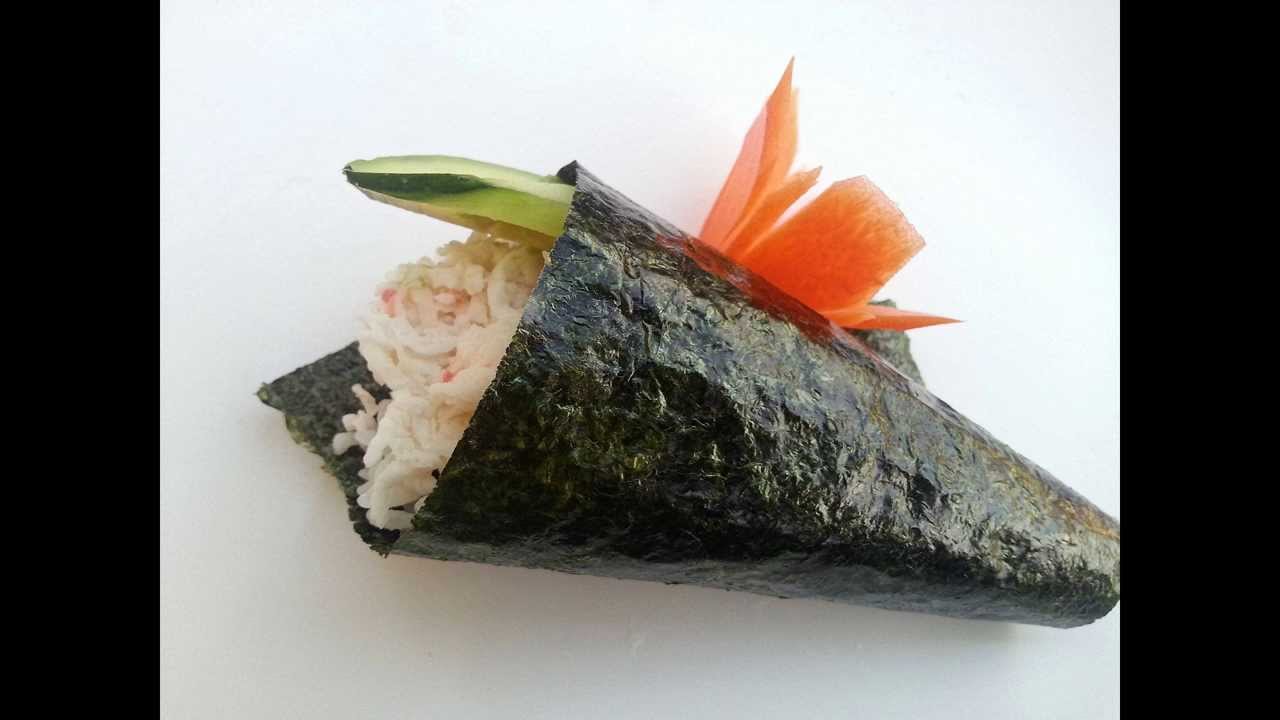
Start a first batch with cucumber and avocado. Cooked fillings come next, and raw fish goes last.
The order follows risk, not flavor. Cucumber and avocado give you rolling practice with nothing to source. Shrimp tempura or hot-smoked salmon shows how much filling a cone holds. Spicy tuna or salmon adds the fish-sourcing step, so it waits.
At a hand roll bar the order flips. Ask for the raw fish roll first, because the chef handles both the rolling and the sourcing.
The trade-off at home is flavor, since a vegetable-first start postpones raw fish until the third roll.
Once the cone rolls cleanly, the other types of sushi rolls are the next skill to learn.


