
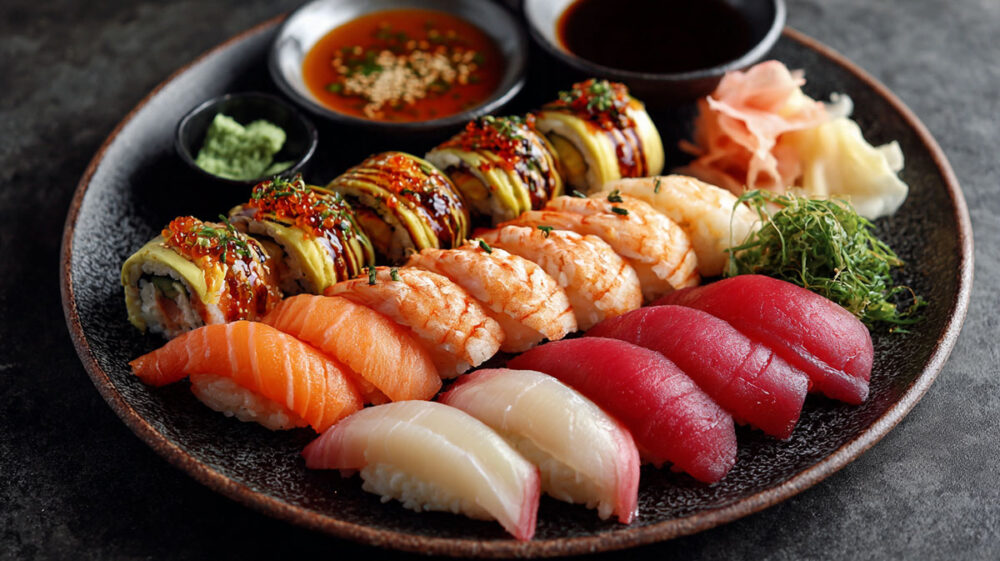
Most people think they know what sushi is made of. They’re usually half right.
Sushi is built on vinegared rice, not raw fish. The fish, seafood, vegetables, and nori that surround it are all secondary to that one core ingredient.
This article breaks down every component: the short-grain rice and its seasoning ratio, the difference between raw and cooked seafood options, what nori grades actually mean, and how sushi ingredients shift between traditional Japanese styles and Western adaptations.
By the end, you’ll know exactly what goes into sushi and why each ingredient matters.
What Is Sushi
Sushi is vinegared rice combined with toppings or fillings. That’s the core definition, and everything else builds from there.
The word “sushi” actually refers to the rice preparation itself, not the fish. A lot of people assume sushi means raw fish. It doesn’t. Raw fish served without rice is called sashimi, which is a completely different dish.
Sushi originated in Edo-period Japan (roughly the 18th and 19th centuries) as a street food sold at outdoor stalls in Tokyo. Early versions used fermented fish pressed onto rice as a preservation method. Modern sushi, especially the hand-pressed nigiri style, is a fairly recent evolution from that tradition.
The global sushi restaurant market was valued at USD 9.52 billion in 2024 and is projected to reach USD 17.62 billion by 2032, according to Data Bridge Market Research. That kind of growth doesn’t happen around a niche food.
Cooked sushi options exist. Vegetarian sushi exists. Sushi with no seafood at all exists. The one non-negotiable ingredient across every style is the rice.
| Common Misconception | Reality |
| Sushi = Raw Fish | Sushi = Vinegared Rice. The word refers to the rice; fish is optional and can be cooked or omitted entirely. |
| Sashimi is Sushi | Sashimi is just the protein. Without the seasoned rice (shari), it does not technically qualify as sushi. |
| Only Seafood is Used | Vegetarian/Egg sushi is traditional. Items like Tamago (omelet), Inari (tofu skin), and fermented soybeans (Natto) are staples. |
| “Sushi Grade” is Law | There is no official regulation. The label is a marketing/retail term; the FDA only regulates “parasite destruction” via freezing. |
Sushi Rice
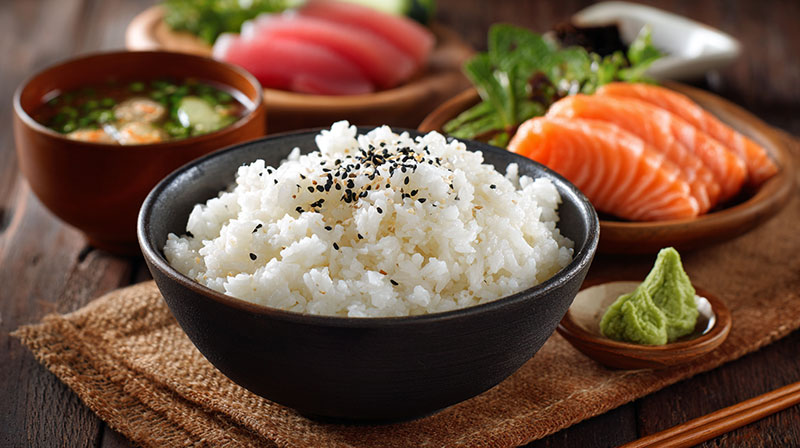
Rice is the foundation. Chef Yasuda of Sushi Yasuda, when asked by Anthony Bourdain whether fresh fish or rice matters more, famously answered “90% rice.” That line has stuck around for a reason.
The Rice Variety
Short-grain Japanese rice is non-negotiable. Koshihikari is the most prized variety and the one used at most quality sushi restaurants worldwide.
It has a naturally higher starch content than long-grain rice, which gives it the slight stickiness needed to hold nigiri together and keep maki rolls from falling apart. Substitute long-grain rice and the whole thing collapses. Literally.
The Seasoning
Sushi rice becomes sushi rice only after it’s seasoned. The standard seasoning blend is rice vinegar, sugar, and salt. The classic ratio used in most Japanese kitchens is 4:2:1 (vinegar:sugar:salt).
Traditional Edomae sushi chefs in Tokyo often skip the sugar entirely, using only rice vinegar and salt for a sharper, cleaner flavor profile. The sweet version is more common in home cooking and Western-style sushi.
The vinegar does more than add flavor. It acts as a mild preservative, which matters in a dish built around raw protein. Seasoning has to happen while the rice is still hot so the grains absorb the mixture evenly. Season it cold and you get a patchy, uneven result.
Rice Temperature and Texture
Body temperature is the target. Sushi rice served too hot destroys the texture of raw fish. Too cold, and the rice becomes gummy and dense.
- Rice must be rinsed until water runs clear, removing excess starch
- Cooked at a 1:1 rice-to-water ratio for a slightly firmer result
- Folded with a cutting motion using a rice paddle, never stirred
- Cooled with a fan while folding to achieve the right gloss
JJ Foodservice launched a premium Japanese short-grain rice line specifically for sushi preparation in February 2025, responding to rising home sushi demand. That tells you something about how seriously the market takes the rice component now.
Fish and Seafood Used in Sushi
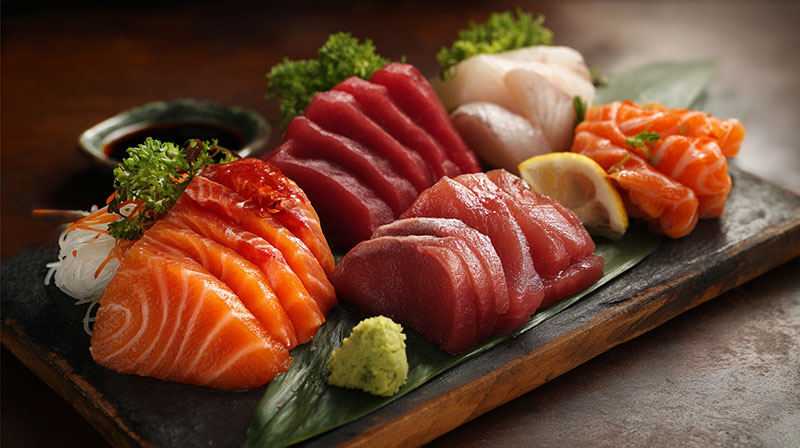
The raw fish segment accounted for the largest ingredient share in the global sushi market in 2023, according to Spherical Insights. Wild-caught fish like tuna and yellowtail dominate traditional menus, but the mix of species varies widely between Japanese and Western-style restaurants.
Raw Fish Options
Most sushi-grade fish used raw goes through strict freezing before it reaches the plate. The FDA Food Code requires fish served raw to be frozen at -4°F (-20°C) for a minimum of 7 days, or at -31°F (-35°C) until solid for at least 15 hours. This kills parasites.
Tuna (maguro) is one exception. Yellowfin, bluefin, and bigeye tuna are exempt from the FDA freezing requirement because of their naturally low parasite risk. This is why top omakase restaurants can serve fresh (never-frozen) tuna.
- Tuna (maguro/toro): Lean cuts (akami) vs. fatty belly cuts (toro and chutoro). Toro is the most expensive.
- Salmon (sake): Almost always farmed for raw use. Wild salmon carries higher parasite risk.
- Yellowtail (hamachi): Buttery, firm. Prized in winter when fat content is highest.
- Sea urchin (uni): Intensely briny. Quality varies dramatically depending on origin and season.
The term “sushi grade” carries no legal definition in the U.S. It is a marketing label, not a regulated standard. Ask any reputable fishmonger how the fish was handled, not just what the sticker says.
Cooked and Cured Seafood Options
Not everything in sushi is raw. A significant portion of traditional and accessible sushi relies on cooked or cured proteins.
Eel (unagi/anago) is always served cooked, glazed with a sweet soy-based tare sauce. It’s one of the oldest nigiri toppings in Edomae sushi history.
| Seafood | Japanese Name | Preparation | Key Flavor Profile |
| Freshwater Eel | Unagi | Grilled, Tare-glazed | Rich, smoky, and sweet; high fat content. |
| Sea Eel | Anago | Simmered/Lightly Grilled | Softer, more delicate and fluffy than Unagi. |
| Shrimp | Ebi | Boiled, Butterflied | Clean, slightly sweet, and firm. |
| Octopus | Tako | Boiled, Sliced Thin | Savory and chewy; usually massaged to tenderize. |
| Crab | Kani | Cooked or Imitation | Naturally sweet or starch-balanced (Surimi). |
Surimi (imitation crab) is the most common filling in a California roll. It’s processed fish paste, not real crab. Worth knowing before you order.
Non-Fish Ingredients in Sushi
Over 200 plant-based sushi products were launched across North America and Europe in 2024 alone, according to market data. Vegetarian and non-seafood sushi is not a modern Western invention, though. Some of it goes back centuries.
Egg (Tamagoyaki)
Tamagoyaki is a sweet, rolled Japanese omelet cooked in layers in a rectangular pan. It’s seasoned with soy sauce, sugar, and mirin. The result is firm, slightly sweet, and subtly savory.
It sits on nigiri rice and is often held in place with a thin nori strip. At traditional sushi restaurants, the quality of the tamagoyaki is sometimes used as a benchmark for the chef’s overall skill. A sloppy tamago is considered a bad sign.
You can read more about this ingredient in our guide on tamago in sushi.
Vegetable Fillings
Standard vegetable ingredients found inside sushi rolls:
- Cucumber (kappa): crisp, neutral, the go-to in kappa maki
- Avocado: a Western addition, now standard in California rolls and most fusion sushi
- Pickled daikon radish (takuan): yellow, crunchy, slightly sweet
- Asparagus, shiso leaf, scallion, and fermented plum (umeboshi) in various regional rolls
Inari and Tofu
Inari sushi uses fried tofu pockets (aburaage) that are simmered in sweet soy broth, then stuffed with seasoned rice. No nori. No fish. Just tofu and rice.
It’s one of the most traditional forms of vegetarian sushi and is eaten widely across Japan. Shrines dedicated to the fox deity Inari (who was said to love fried tofu) are where the name comes from. Learn more in our full breakdown of inari sushi.
Nori and Other Wrappers
Nori holds most sushi together. It is dried and toasted red algae (Porphyra species), pressed into thin flat sheets. Japan, South Korea, and China are the three main commercial producers.
Nori Grades and Quality
Nori is sold in graded quality tiers. The highest grade is gold, followed by silver, then green. Gold-grade nori is thicker, more uniform, and has a cleaner ocean flavor. Lower grades are thinner, more brittle, and sometimes blended from multiple seaweed species.
Key quality indicators when buying nori:
- Shiny surface on one side (the side that faces outward in a roll)
- Deep green color after toasting (raw nori is purple-red before processing)
- Dry, brittle texture, not soft or damp
- Consistent thickness without holes or tears
Nori contains only 35 calories per 100 grams (USDA) and carries notable amounts of iodine, vitamins A and C, and polyunsaturated fatty acids. It’s nutritionally dense for something that weighs almost nothing.
Alternative Wrappers
Nori is not the only option. Some sushi skips it entirely.
Soy paper is used in fusion rolls when a milder flavor or different color is preferred. It has no seaweed taste, which makes it popular in Western-style restaurants.
Cucumber wraps replace nori in low-carb preparations. Thin cucumber sheets are sliced lengthwise and used to encase the rice and filling. Some omakase restaurants do this for aesthetic contrast and texture.
Temaki (hand rolls) use nori in a cone shape rather than a flat sheet. The ratio of nori to rice is much higher, and they must be eaten immediately before the nori softens.
Sushi Condiments and Seasonings
The condiments served with sushi are not decorations. Each one has a specific purpose, and most people use them wrong.
Soy Sauce
Soy sauce is for dipping, not drenching. The standard approach is to dip the fish side of a nigiri lightly into soy sauce, not the rice side. Rice absorbs soy sauce instantly and falls apart.
Pouring soy sauce directly over a bowl of sushi rice is something that makes sushi chefs visibly uncomfortable. The vinegar seasoning in the rice is already calibrated. Flooding it with soy sauce overwrites that entirely.
Tamari (wheat-free soy sauce) and low-sodium versions are common substitutes. Most restaurants outside Japan use Chinese-style soy sauce, which is saltier and less nuanced than Japanese shoyu.
Wasabi
Real wasabi (hon-wasabi) is made from the grated rhizome of Wasabia japonica. It’s bright green, has a clean heat that fades quickly, and costs significantly more than the alternative. Almost no restaurant outside Japan uses it.
What most people eat as “wasabi” is horseradish paste mixed with mustard powder and green food dye. It has a harsher, more prolonged heat. It works, but it’s not the same thing.
Hon-wasabi is typically applied by the chef directly to nigiri before serving. Mixing a large blob of fake wasabi into soy sauce is not how it’s traditionally used, though most people do it anyway.
Pickled Ginger (Gari)
Gari is thinly sliced young ginger pickled in sweet vinegar. Its purpose is to cleanse the palate between different pieces of sushi, not to eat alongside a single piece.
- Pale pink or beige when naturally pickled (no dye)
- Bright pink when artificial coloring is added (very common in cheaper restaurants)
- Served on the side, not stacked on top of sushi
If you want to know which wine goes with sushi, the palate-cleansing role of gari matters for pairing decisions. It resets your taste between pieces, which is exactly what a good wine pairing should do between bites of different fish.
Main Types of Sushi and Their Ingredients
The maki segment dominated the global sushi market in 2023, according to Spherical Insights. Rolls are portable, shareable, and endlessly variable. That explains their lead.
But maki is not where the range of sushi roll types ends. Each style below uses the same core ingredients differently, producing results that taste and feel almost nothing alike.
Nigiri and Gunkan
Nigiri is hand-pressed rice with a slice of fish or seafood laid on top. Two ingredients. No roll, no wrapper in most cases.
A small smear of wasabi sits between the rice and the fish. Some chefs press a thin nori strip around gunkan-style pieces (like sea urchin or fish roe) to form a small “boat” that contains loose toppings.
- Rice is shaped by hand, roughly two-finger length
- Eaten by hand in Japan, fish-side down toward the tongue
- One bite per piece, no cutting required
Nigiri is what most Japanese people picture when they hear the word sushi. The Western association with rolls is a different story entirely.
Maki and Its Variations
Classic maki is nori on the outside, rice and filling inside, sliced into rounds. Simple. The variations get more complicated.
Hosomaki: thin roll, single filling, typically one ingredient like tuna (tekka maki) or cucumber (kappa maki).
Futomaki: thick roll, multiple fillings, often vegetables and egg. Common in bento boxes.
Temaki: cone-shaped hand roll, not cut into rounds. Must be eaten immediately before the nori softens.
Fusion sushi demand rose 52% between 2023 and 2025, according to market data from Market Reports World, largely driven by maki variations incorporating global ingredients.
Uramaki (Inside-Out Rolls)
Uramaki is the most popular sushi type in the United States. The rice sits on the outside; the nori is hidden inside, wrapped around the filling.
A Los Angeles chef named Ichiro Mashita invented it in the late 1960s after noticing American diners were put off by the visible seaweed. The California roll was the direct result. It contains imitation crab, avocado, and cucumber.
Common uramaki toppings on the outside layer:
- Toasted sesame seeds
- Tobiko (flying fish roe)
- Sliced raw fish (rainbow roll style)
- Sliced avocado or cucumber
In Japan, uramaki is uncommon. The outer rice layer is messy to eat by hand.
Chirashi and Oshi
Two sushi styles that skip the rolling entirely.
Chirashi is scattered sushi: a bowl of seasoned rice with raw fish, seafood, and garnishes arranged on top. No assembly beyond that. It’s the format most sushi chefs make for themselves at home, frankly.
Oshi (pressed sushi) comes from Osaka. Rice and fish are packed into a rectangular wooden mold, pressed firmly, then sliced into blocks. The Osaka style uses sweeter rice and tends toward heavier, more robust toppings compared to Edomae nigiri.
| Style | Rice Position | Wrapper | Origin |
| Nigiri | Base (hand-pressed) | None (or nori strip) | Edo (Tokyo) |
| Maki | Inside | Nori outside | Japan |
| Uramaki | Outside | Nori inside | Los Angeles, 1960s |
| Temaki | Inside cone | Nori cone | Japan |
| Chirashi | Bowl base | None | Japan (Regional) |
What Makes Sushi Ingredients Different by Region
Japanese sushi and Western sushi share the same name. The ingredient philosophy behind each is almost opposite.
North America saw a 44% increase in sushi-focused restaurant chains between 2019 and 2024, according to Global Growth Insights. More restaurants, more regional variation, more distance from the original format.
Traditional Edomae Sushi (Tokyo)
Edomae sushi uses the fewest possible ingredients.
One topping. One seasoning applied by the chef. Rice that has been carefully calibrated in vinegar ratio and temperature. The restraint is the point.
Key features:
- No avocado, no cream cheese, no spicy mayo
- Fish often cured, aged, or lightly marinated rather than served purely fresh
- Seasonal rotation: what’s available drives the menu, not the other way around
Sushi Ouji in San Francisco ships fish twice weekly directly from Tokyo’s Toyosu Market to maintain this standard outside Japan.
Osaka-Style Sushi
Osaka is where oshi (pressed sushi) dominates. The rice tends to be sweeter than Edomae style.
Ingredients lean toward more pronounced flavors: mackerel cured in vinegar (battera), thick omelets, and pickled vegetables. Less focus on ultra-fresh raw fish, more focus on preserved and layered flavors.
Some see it as sushi’s more food-forward, flavor-first counterpart to Tokyo’s minimalism.
Western and American Sushi
The ingredient list expands dramatically. Cream cheese, spicy mayo, tempura batter, teriyaki sauce, jalapeenos, avocado, mango. Some rolls have six or seven components.
The goal shifts from showcasing a single fish to building a flavor combination. This is not inherently worse. It’s just different from what sushi was built to do.
American sushi restaurants in southern states sometimes use crawfish as a local protein in rolls. Mexican-inspired rolls include lime, cilantro, and chipotle. The format adapts wherever it lands.
| Region | Rice Style | Ingredient Approach | Typical Format |
| Tokyo (Edomae) | Sharp, Red Vinegar (Akazu) | 1–2 ingredients; focus on curing | Nigiri or thin Maki |
| Osaka | Sweeter, seasoned rice | Cured, layered, and pressed | Oshizushi (boxed) |
| USA / Western | Standard seasoning | Multi-component; sauce-heavy | Uramaki (Inside-out) |
| Brazil | Standard seasoning | Dairy-heavy (Cream cheese/Catupiry), fruit | Hot Rolls, Temaki |
Ingredient Quality Standards Across Formats
High-end omakase and a conveyor belt sushi chain can use the same species of fish. The gap between them is sourcing, handling, and timing.
Omakase menus are seasonal by definition. Michelin-recognized omakase in Tokyo sources fish from specific Toyosu Market vendors by name, with chefs selecting fish daily based on what arrived that morning. Prices range from $150 to over $450 per person, according to InsideHook’s 2024 guide.
At Ju-Ni, an omakase counter in San Francisco, executive chef Geoffrey Lee estimates roughly 90% of seafood comes from a single Tokyo-based supplier (Sakasyu) that ships fish twice weekly directly from the Toyosu Market.
Conveyor belt chains use the same raw ingredients at volume. The difference is not the species. It’s how recently it was caught, how it was handled, and who selected it.
Learn more about how to enjoy sushi with the right miso soup pairing alongside your meal, or explore what wine pairs best with Japanese food more broadly if you’re planning a full spread.
FAQ on What Is Sushi Made Of
What is the main ingredient in sushi?
Sushi rice is the defining ingredient. It’s short-grain Japanese rice seasoned with rice vinegar, sugar, and salt. Everything else, fish, vegetables, nori, is secondary. No rice means no sushi.
Does sushi always contain raw fish?
No. Many sushi types use cooked seafood like shrimp (ebi) or eel (unagi), or no seafood at all. Vegetarian sushi using cucumber, avocado, and tamagoyaki is fully traditional in Japanese cuisine.
What type of rice is used in sushi?
Short-grain Japanese rice, most commonly the Koshihikari variety. Its higher starch content creates the slight stickiness needed to hold nigiri together. Long-grain rice won’t work as a substitute.
What is nori in sushi?
Nori is dried, toasted seaweed pressed into thin flat sheets. It wraps maki rolls and temaki cones. Nori quality is graded gold, silver, and green, with gold being the thickest and most flavorful.
What does sushi-grade fish mean?
“Sushi-grade” has no official legal definition in the U.S. It’s a marketing term. What actually matters is whether the fish was frozen to FDA parasite-destruction standards, at -4°F for 7 days minimum.
What is wasabi made from?
Real wasabi comes from the grated rhizome of Wasabia japonica. Most restaurants outside Japan serve a substitute made from horseradish, mustard powder, and green dye. The heat and flavor profile differ noticeably.
What is the difference between sushi and sashimi?
Sushi always contains vinegared rice. Sashimi is sliced raw fish or seafood served without rice. They share similar ingredients but are fundamentally different dishes.
What is tobiko in sushi?
Tobiko is flying fish roe, the small, crunchy orange eggs found on the outside of many uramaki rolls. It adds texture and a mild briny flavor. Masago (capelin roe) is a cheaper, smaller alternative.
What fillings are in a California roll?
A California roll contains imitation crab (surimi), avocado, and cucumber. It’s an uramaki style, meaning rice is on the outside and nori sits inside. Created in Los Angeles in the late 1960s.
Is sushi rice different from regular rice?
Yes. Regular cooked rice has no seasoning. Sushi rice is folded with a vinegar, sugar, and salt mixture while still hot. The classic ratio is 4:2:1 (vinegar to sugar to salt). Texture and flavor differ completely.
Conclusion
This conclusion is for an article presenting what sushi is made of, and the answer comes down to a few well-chosen components working together.
Sushi-grade fish, short-grain Koshihikari rice, nori, and condiments like gari and hon-wasabi each play a specific role. None of them are interchangeable.
The gap between nigiri and a California roll isn’t just style. It reflects entirely different ingredient philosophies, from Edomae simplicity to Western fusion layering.
Understanding those differences changes how you order, how you eat, and what you actually taste.
Whether you’re exploring how to eat sushi properly or curious about tobiko, tamagoyaki, and inari, the ingredients always tell the full story.


