
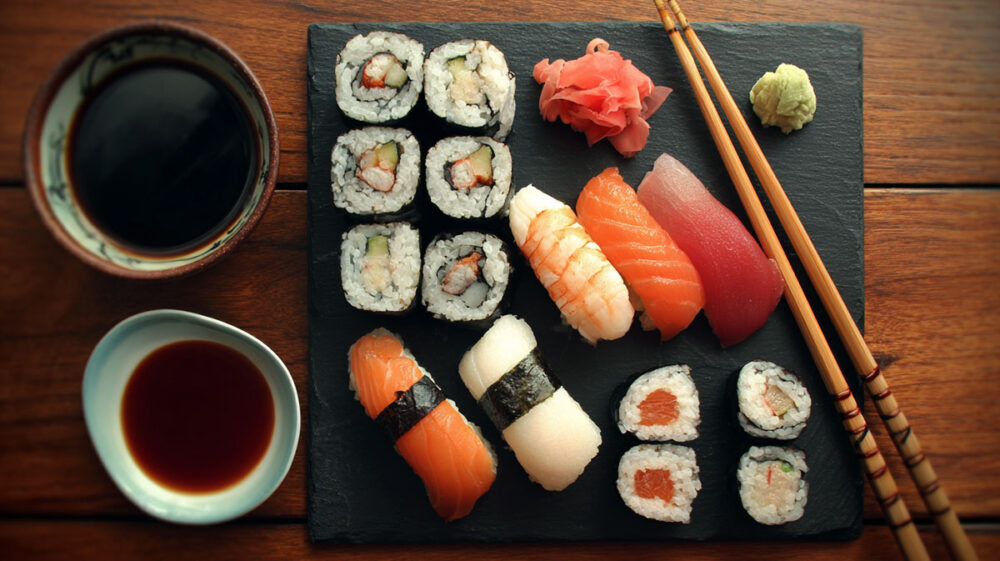
Sushi and kashrut have more in common than most people think.
Whether sushi is kosher depends on the fish species, the rice preparation, the condiments, and who cooked it. The answer is rarely a straight yes or no.
Jewish dietary laws draw a clear line: fish with both fins and scales are permitted, shellfish are not. Salmon and tuna are fine. Eel, shrimp, and crab are off the table. But the kosher status of a full sushi roll involves a lot more than just the fish.
This guide covers which rolls are permitted, which ingredients require certification, and what changes during Passover.
What Does Kosher Mean for Sushi
Kosher law, rooted in kashrut, is the system of Jewish dietary rules derived from Leviticus and Deuteronomy. It governs which foods are permitted, how they must be prepared, and which combinations are forbidden. When it comes to sushi, kashrut applies across every component: the fish, the rice, the nori, and even the soy sauce on the side.
The global kosher food market reached USD 22.1 billion in 2024 (IMARC Group), a figure that reflects growing interest well beyond Jewish communities. Around 44% of American consumers now prefer kosher-labeled products, at least partly for perceived quality and safety reasons (Global Growth Insights, 2024).
Kosher food falls into three main categories:
- Fleishig (meat): land animals and poultry slaughtered under rabbinical supervision
- Milchig (dairy): milk, cheese, cream, butter
- Pareve (neutral): fish, eggs, fruits, vegetables, and grains that are neither meat nor dairy
Fish used in sushi is pareve by default. That means it can theoretically be eaten alongside either meat or dairy dishes. But whether the fish itself is permitted depends on a single, clear rule from Leviticus 11:9.
The core rule: fish must have both fins and scales to be considered kosher. No exceptions.
This single requirement determines whether a sushi roll is permitted or not before you even look at anything else on the plate.
Which Fish in Sushi Are Kosher
Fins and scales. That is the complete biblical standard. Any fish that has both is kosher; anything that lacks either one is not.
For sushi specifically, this creates a clear divide:
| Fish | Kosher Status | Common Sushi Use |
| Salmon | Permitted | Universal staple; high omega-3s |
| Tuna | Permitted | Lean and fatty cuts (Akami, Toro) |
| Yellowtail (Hamachi) | Permitted | Prized for buttery texture |
| Sea Bass | Permitted | Delicate white fish |
| Eel (Unagi/Anago) | Forbidden | Lacks removable scales |
| Octopus / Squid | Forbidden | Mollusks lack fins and scales |
| Shellfish (Shrimp/Crab) | Forbidden | Crustaceans are non-kosher |
Eel is the one that surprises people most. It is one of the most popular sushi fish worldwide, but it has no scales. Completely off the table for those keeping kosher.
Swordfish is another tricky case. It was once considered kosher but was later ruled forbidden because it loses its scales as it matures, keeping them only in juvenile form. The Orthodox Union does not certify swordfish as kosher for this reason.
The Surimi Problem
Surimi, the pressed fish paste used to make imitation crab, is typically made from Alaskan pollock, a fish with both fins and scales. Kosher in theory. The problem is everything else that goes into it.
Three things make most surimi non-kosher:
- Shellfish broth added for flavor (real crab extract is common in commercial surimi)
- Shared processing equipment used for actual shellfish and crustaceans
- Non-kosher colorants, binders, or preservatives with no certification
Certified kosher surimi does exist. Brands like Dyna-Sea produce pollock-based surimi sticks under OU supervision, using kosher crab flavoring instead of actual shellfish. But you need the certification symbol to be sure. Without it, the safest position is to treat any imitation crab as non-kosher.
Rice, Nori, and Sushi Vinegar
Short-grain rice is inherently kosher. No special certification needed for the grain itself. The sushi preparation process is where things get more complicated.
Sushi vinegar (rice vinegar, sugar, salt) is generally kosher but should be certified if it contains added flavorings. Plain rice vinegar from a certified brand is fine. Seasoned versions sometimes contain flavor additives that need checking.
The bigger issue is the rice cooker. According to the Chicago Rabbinical Council (cRc), kosher supervision requires a Jewish person to physically turn on the rice cooker each time a new batch is started, satisfying the rule of bishul Yisrael (food cooked with Jewish involvement). Many rice cookers shut off automatically, which means the mashgiach has to be present at the start of every single batch. This is one reason full kosher sushi certification is operationally demanding for restaurants.
Nori and the Insect Checking Requirement
Nori (dried seaweed) is pareve and generally kosher. But it requires checking. Several brands have been recalled or flagged by kosher agencies due to infestation by small crustaceans called amphipoda, tiny crab-like organisms that can be trapped between seaweed sheets during processing.
Kof-K flagged specific lots of Yama Moto Yama sushi nori as recently as 2023, requiring additional inspection for tola’im (insects or prohibited organisms) before use. The Star-K has similarly recalled multiple nori brands for unauthorized kosher symbols or infestation issues.
Bottom line: certified nori from a reputable agency is not optional for those keeping strict kosher. The Torah prohibition on consuming insects applies, and nori is a documented risk category.
Soy Sauce, Wasabi, and Condiment Issues
Most people assume condiments are a non-issue. They are not.
Soy sauce is fermented wheat and soybeans. Standard soy sauce brands like Kikkoman are not certified kosher for all markets, and some formulations include fermentation agents that require rabbinical review. Tamari is generally safer (lower wheat content or wheat-free) but still needs a certification symbol to be reliable.
A practical comparison of common sushi condiments:
| Condiment | Default Status | Key Concern |
| Soy Sauce | Requires Certification | Fermentation agents and wheat-based additives |
| Tamari | Requires Certification | Similar risks; often processed on shared equipment |
| Wasabi Paste | Requires Certification | Horseradish fillers, colorants, and stabilizers |
| Real Wasabi | Generally Kosher | Pure root; rarely used due to high cost ($200/kg) |
| Pickled Ginger | Usually Fine | Artificial dyes (like Red #40) in some brands |
Wasabi paste sold in most sushi restaurants is not real wasabi. It is typically a mix of horseradish, mustard, and green food coloring. The colorants and flavorings used may come from non-kosher sources. Real wasabi root, grated fresh, is a different story but nearly impossible to find outside high-end certified restaurants.
Spicy mayo deserves a specific mention. It combines mayonnaise (eggs, oil) with sriracha or chili paste. The eggs need to be from a kosher source, and the hot sauce needs its own certification. Most spicy mayo at non-certified restaurants fails one of these tests.
The Meat-Fish Separation Rule
Fish is pareve. It is neither meat nor dairy. So you would think fish and meat together at the same meal is fine. It is not that simple.
The Talmud (Pesachim 76b) cites a health concern about eating fish and meat together, and the Ashkenazi tradition, following this source, prohibits mixing them. The Rema (Rabbi Moshe Isserles) codified this position in the Shulchan Aruch for Ashkenazi Jews.
What this means practically for a sushi dinner:
- Eating a sushi platter alongside a beef dish requires separate plates and utensils
- A kosher restaurant that serves both meat dishes and sushi must manage this separation actively
- Some Ashkenazi communities wait between eating fish and meat, similar to the wait between meat and dairy
Sephardic Jews do not follow this restriction. For Sephardic communities, fish and meat can be eaten in the same meal, which simplifies kosher sushi dining considerably at restaurants that serve both.
One thing that does not apply here: fish and dairy can be combined under most rulings. A Philadelphia roll with cream cheese and salmon is not a meat-dairy mixing issue. That is a different question entirely, covered in the next section.
Dairy and Fish Combinations in Sushi
The Philadelphia roll sits at the center of a real halakhic debate. It combines cream cheese with smoked salmon. Is that kosher?
For most Jews: yes, if the ingredients are certified. Fish and dairy do not fall under the biblical prohibition against mixing meat and dairy. The Torah says “do not boil a kid in its mother’s milk,” referring specifically to the flesh of mammals, not fish.
The minority exception: a small number of Ashkenazi authorities, citing the Rema and subsequent commentators, advise against fish and dairy together. This is not universally practiced even within Ashkenazi communities, and it is a rabbinical caution rather than a biblical prohibition.
Practically speaking:
- Most kosher-certified sushi restaurants in the US serve Philadelphia rolls without issue
- OU-certified products that combine salmon and cream cheese are available in retail
- Sephardic communities have no restriction here at all
The bigger issue with cream cheese in sushi rolls is the dairy certification itself. Cream cheese must come from kosher milk, processed on kosher equipment. Philadelphia Cream Cheese carries OU-D certification and is widely accepted. Generic or store-brand cream cheeses used in restaurant kitchens may not have the same oversight.
If the ingredients are certified and the kitchen is supervised, a salmon and cream cheese roll is a perfectly valid kosher option. The range of kosher sushi rolls is wider than most people assume once you know which ingredients to check.
Kosher Certification for Sushi Restaurants
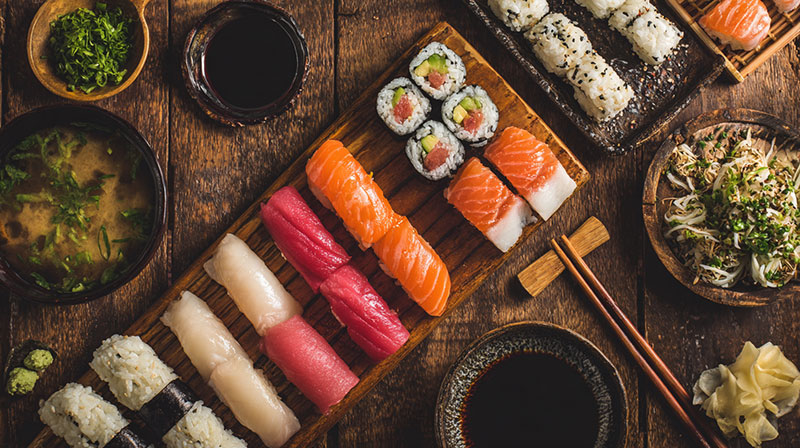
Full kosher certification for a sushi restaurant is one of the more operationally demanding certifications in the food industry. Every ingredient, every piece of equipment, and every cooking process requires rabbinical review.
The Orthodox Union currently certifies over 800,000 products across more than 9,000 plants in 104 countries (OU Kosher, 2024). The “Big Five” agencies (OU, OK, Kof-K, Star-K, and CRC) together certify more than 80% of kosher food sold in the US, according to Wikipedia’s summary of industry data.
What Certification Actually Requires
Ingredients: every item used must be pre-approved, from fish to rice vinegar to soy sauce.
Supervision: a mashgiach (rabbinical supervisor) must be present, particularly to ensure bishul Yisrael compliance when rice and fish are cooked.
Equipment: knives, cutting boards, and rolling mats must be dedicated to kosher use and cannot be shared with non-kosher ingredients.
Ongoing audits: kosher status can be revoked if standards slip. The OU’s field representatives conduct regular site visits to confirm ongoing compliance.
In New York City, kosher sushi has grown into a genuine dining category. Akimori, operating since 2021 across Brooklyn and the Upper East Side, offers full omakase experiences under kosher supervision. Sen Sakana in Midtown Manhattan blends Japanese and Peruvian cooking under certified hashgacha. Both represent how seriously the kosher dining scene has taken the nutritional and culinary appeal of sushi.
Choosing a Certification Agency
Not all symbols carry equal weight in every community. Orthodox Jews generally require one of the Big Five agencies. For Conservative Jews, a broader range of regional certifications may be acceptable.
| Agency | Symbol | Acceptance Level |
| Orthodox Union | OU | The world’s largest and most widely recognized agency. |
| OK Kosher | OK | Highly respected with a massive global reach. |
| Star-K | Star-K | Known for expertise in food technology and appliance certification. |
| Kof-K | KOF-K | One of the most prominent international certifiers. |
| CRC (Chicago) | cRc | A regional giant with national-level authority on policy. |
A restaurant displaying a symbol from a lesser-known local agency may not be accepted by all observant customers. When in doubt, the standard advice is to ask your rabbi which agencies are considered reliable in your community.
Can You Eat Sushi at a Non-Certified Restaurant
Short answer: for Orthodox Jews, no. For others, it depends.
The issue is not just ingredients. Cross-contamination from shared cutting boards, knives, and prep surfaces that have touched shrimp, crab, or eel is a real and routine concern at any non-certified sushi restaurant. The fish itself might be kosher species, but the moment it is prepped on the same surface as non-kosher seafood, the halachic status changes.
The Bishul Akum Complication
Beyond cross-contamination, there is the question of bishul akum, the rabbinic restriction against food fully cooked by non-Jews.
According to the cRc (Chicago Rabbinical Council), cooked sushi rice is subject to bishul akum concerns since rice qualifies as food fit for a “king’s table” under halachic criteria. The Halachipedia reference to this topic confirms that parboiled rice prepared solely by non-Jewish manufacturers is considered bishul akum even before it reaches the restaurant.
Raw fish is different. Because sashimi-grade fish is increasingly consumed raw, several halachic authorities have explored whether raw fish is now exempt from bishul akum, since the prohibition does not apply to foods eaten raw. The cRc notes the matter is still debated and that Poskim have not yet ruled that fish is universally exempt based on sushi’s popularity.
What this means in practice: even a simple cucumber roll from an uncertified restaurant presents problems beyond just the ingredients.
Where the Lines Fall by Community
Orthodox: Generally requires full hashgacha. An uncertified restaurant is off-limits regardless of which rolls you order.
Conservative: The Committee on Jewish Law and Standards permits more flexibility, but observant Conservative Jews still typically look for some level of supervision or certified ingredients.
Reform: Individual choice guides practice. Many Reform Jews focus on avoiding clearly forbidden items like shrimp and eel, without requiring full certification.
There is no universally “safe” approach to non-certified sushi for those keeping kosher. The level of observance determines the level of restriction, and that is a conversation best had with a knowledgeable rabbi rather than guessed at based on a menu.
Passover-Specific Sushi Restrictions
Passover changes the equation entirely. Even fully kosher sushi becomes off-limits for many Jews during the eight-day holiday, and for reasons that have nothing to do with shellfish.
The central issue is rice. For Ashkenazi Jews, rice is classified as kitniyot, a category of foods banned during Passover since the 13th century. The prohibition was enacted because kitniyot grains can be ground into flour and might be confused with chametz (leavened grain), according to Chabad’s documentation of the ruling.
In 2015, the Conservative movement’s Committee on Jewish Law and Standards issued responsa lifting the kitniyot ban for Conservative Ashkenazi Jews, overturning an 800-year-old ruling. The Forward reported this directly opened the door to Passover sushi for Conservative communities. Orthodox Jews remain bound by the original prohibition.
Who Can Eat Sushi on Passover
The divide breaks cleanly by tradition:
- Ashkenazi Orthodox: No sushi rice. Sashimi over certified kosher-for-Passover fish is technically permitted if the kitchen is kashered for Passover.
- Ashkenazi Conservative: Rice now permitted following the 2015 ruling, so sushi is theoretically possible with certified ingredients.
- Sephardic Jews: Rice has never been banned for Passover. Sushi with certified kosher-for-Passover ingredients is fully permitted.
- Reform Jews: Generally follow individual custom; many eat rice on Passover.
Soy Sauce and Chametz on Passover
Soy sauce contains wheat. Wheat is chametz. So standard soy sauce is off the table for everyone during Passover, regardless of denomination.
Tamari made without wheat exists and some brands produce kosher-for-Passover versions. But checking the label is not optional. A plain “tamari” label does not guarantee Passover compliance without a kosher-for-Passover certification symbol.
The practical workaround many kosher-observant sushi lovers use during Passover is to make sushi at home. You control the fish source, the rice (if you permit kitniyot), the kosher-for-Passover tamari, and the cutting boards. Alternatively, sashimi from a supervised source sidesteps the rice question entirely for Ashkenazi Orthodox Jews.
Curious about how wine pairs with a kosher sushi meal? That is a separate question worth exploring, especially given that grape products made by non-Jews present their own kosher concerns under the rules of stam yainom.
FAQ on Is Sushi Kosher
Is sushi kosher?
Sushi can be kosher, but it depends entirely on the ingredients and how it was prepared. Rolls made with permitted fish like salmon or tuna, certified rice, and kosher condiments qualify. Anything containing shellfish, eel, or uncertified ingredients does not.
Is a California roll kosher?
Usually not. The standard California roll contains imitation crab (surimi), which requires kosher certification to be permitted. Most commercial surimi lacks that certification due to shared processing equipment and non-kosher additives or shellfish flavorings.
Is a spicy tuna roll kosher?
Tuna has fins and scales, so the fish itself is kosher. The issue is the spicy mayo. It must use certified kosher eggs and certified hot sauce. At a non-certified restaurant, there is no way to verify either.
Is eel kosher?
No. Eel lacks scales, which makes it forbidden under kashrut regardless of preparation method. Unagi nigiri and eel rolls are off-limits for anyone keeping kosher. This rules out a large portion of standard sushi menus.
Is soy sauce kosher for sushi?
Standard soy sauce requires kosher certification. It is fermented with wheat and may contain processing agents that need rabbinical review. Tamari is a safer option but still needs a certification symbol to be reliable.
Can Jews eat sushi at a regular restaurant?
Orthodox Jews generally cannot. Cross-contamination from non-kosher seafood, uncertified ingredients, and the absence of rabbinical supervision all disqualify a standard restaurant. Conservative and Reform Jews apply varying levels of restriction depending on personal practice.
Is nori kosher?
Nori is pareve and generally kosher, but it requires certified brands. Several nori products have been recalled by agencies like Kof-K and Star-K due to infestation by small crustaceans trapped between sheets during processing.
Is a Philadelphia roll kosher?
Yes, if the ingredients are certified. Salmon and cream cheese can be combined under most kosher rulings. Fish and dairy are not subject to the meat-dairy prohibition. Philadelphia Cream Cheese carries OU-D certification and is widely accepted.
Is sushi kosher for Passover?
For Ashkenazi Orthodox Jews, no. Rice is classified as kitniyot and is forbidden during Passover. Sephardic Jews permit rice, so certified sushi is allowed. Soy sauce containing wheat is off-limits for everyone regardless of denomination.
What sushi rolls are kosher?
Rolls made with salmon, tuna, yellowtail, or sea bass paired with certified rice, nori, and condiments qualify. Cucumber rolls, avocado rolls, and Philadelphia rolls with certified ingredients are all viable options at a properly supervised kosher sushi restaurant.
Conclusion
This conclusion is for an article presenting the full picture of kosher sushi, and the answer is clear: it is possible, but never automatic.
Permitted fish like tuna, salmon, and yellowtail form a solid base. The problems show up in the condiments, the nori, the surimi, and the kitchen itself.
Hashgacha from a recognized agency is the only reliable way to confirm that a sushi meal meets kashrut standards from fish to rice cooker.
Passover adds another layer, splitting Ashkenazi and Sephardic practice further apart on the kitniyot question.
Whether you follow Orthodox, Conservative, or Reform practice, understanding the halakha behind each ingredient puts you in a much stronger position at any sushi bar.


