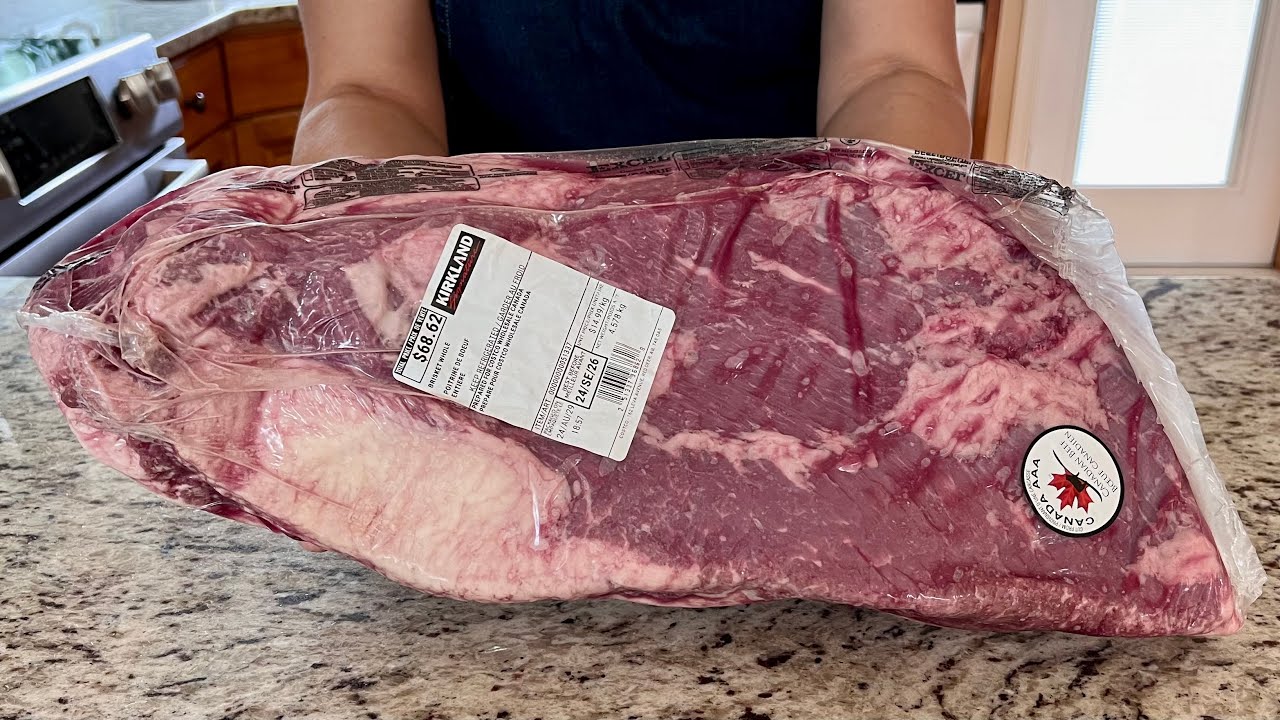
Costco sells whole packer briskets under the Kirkland Signature label. You’ll find both USDA Prime and USDA Choice grades in the meat department, vacuum sealed and ready to go.
These come as full packer cuts. That means both the flat and the point are included.
Most weigh between 12 and 18 pounds. Took me forever to figure out how to fit one in my smoker the first time.
This guide covers three cooking methods: smoking, oven roasting, and slow cooker. Time ranges from 8 hours to 18+ hours depending on your approach.
You’ll need a meat thermometer. No exceptions here.
Product Details
Product: Kirkland Signature USDA Prime Beef Brisket (or USDA Choice)
Type: Fresh, refrigerated (not frozen)
Package Size: 12-18 lbs (14 lb average for Prime), serves 20-28 people
Price: $3.59-$4.59/lb for Prime, $3.00-$3.50/lb for Choice at Costco (Updated December 2025)
Storage: Refrigerate at 40 degrees F or below
Calories per Serving: 280 calories per 3 oz cooked serving
Main Ingredients: Beef brisket (contains both flat cut and point cut)
Item Number: 241614 (Prime), varies by location for Choice
Cooking Methods Comparison
| Method | Time | Equipment | Result | Best For |
| Smoker | 10–16 hours | Pellet grill, offset, or kamado | Smoky bark, tender inside | Texas-style BBQ |
| Oven | 5–8 hours | Roasting pan, foil | Tender, braised texture | Weeknight meals, Jewish-style |
| Slow Cooker | 8–12 hours | 6–8 quart crock pot | Fall-apart tender | Hands-off cooking |
Recommended Method: Smoker for the best bark formation and authentic Texas barbecue flavor with maximum smoke ring development.
Method 1: Smoker (Recommended)

Smoking a whole packer brisket takes 10-16 hours at 225-275 degrees F. You’ll get that signature smoke ring, crusty bark, and melt-in-your-mouth tender beef. Plan to serve 20+ people or have plenty of leftovers.
Step 1: How Do You Prepare the Brisket?
Trim the fat cap to about 1/4 inch thick. Remove any hard fat between the point and flat.
Instructions:
- Pat the brisket dry with paper towels
- Trim fat cap down to 1/4 inch using a sharp boning knife
- Remove silver skin from the bottom
- Apply a thin layer of yellow mustard as a binder
- Season generously with your dry rub (salt and pepper works great)
Equipment: Sharp boning knife, cutting board, paper towels, spray bottle
Step 2: What Temperature and Time Do You Use?
Set your smoker to 225-250 degrees F. Expect about 1 to 1.5 hours per pound of meat.
Instructions:
- Preheat smoker to 225-250 degrees F
- Add wood chips or pellets (post oak or hickory work best)
- Place brisket fat side up on the grill grate
- Insert meat thermometer probe into thickest part of the flat
Temperature: 225-275 degrees F pit temperature
Time: 10-16 hours for a 14 lb brisket
Step 3: When Do You Wrap the Brisket?
Wrap when the internal temperature hits 165-170 degrees F. This is called the Texas Crutch.
Instructions:
- Check internal temp every hour after 5 hours
- When bark is dark and temp reaches 165 degrees F, remove from smoker
- Wrap tightly in pink butcher paper or aluminum foil
- Return to smoker and continue cooking
Checkpoint: At 165 degrees F internal temperature. The stall happens here. Wrapping helps push through it.
Step 4: How Do You Know When It’s Done?
The brisket is done when a probe slides in like butter. Internal temp should read 195-205 degrees F.
Instructions:
- Start checking probe tenderness at 195 degrees F
- Probe should slide into the meat with almost no resistance
- Remove from smoker and rest for at least 1 hour
- For best results, rest 2-4 hours in a cooler wrapped in towels
Target Temperature: 195-205 degrees F internal
Visual Indicator: Dark mahogany bark, jiggles like Jell-O when shaken
Method 2: Oven
Oven braising produces a tender, juicy brisket in 5-8 hours. The technique works well for flat cut briskets or when you don’t have smoker access. You won’t get a smoke ring, but the meat falls apart beautifully.
Step 1: How Do You Prepare the Brisket?
Sear the brisket before roasting. This builds flavor and creates a nice crust.
Instructions:
- Bring brisket to room temperature (about 1 hour)
- Season all sides with salt, pepper, garlic powder, and paprika
- Heat oil in a heavy roasting pan over high heat
- Sear each side for 4-6 minutes until browned
Equipment: Heavy roasting pan, aluminum foil, meat thermometer
Step 2: What Temperature and Time Do You Use?
Low and slow wins the race. Start at 325 degrees F, then drop to 275 degrees F.
Instructions:
- Preheat oven to 325 degrees F
- Add 1 cup beef broth to the pan
- Cover tightly with foil
- Cook for 1 hour, then reduce to 275 degrees F
- Continue cooking until internal temp reaches 195 degrees F
Temperature: 275-325 degrees F
Time: 1 hour per pound (5-8 hours for most briskets)
Step 3: When Do You Check the Brisket?
Check liquid levels halfway through. Add more broth if the pan looks dry.
Instructions:
- Check at the 3-hour mark
- Add 1/2 cup broth if needed
- Re-seal foil tightly
Checkpoint: At 3-hour mark for liquid, then hourly for temperature after 5 hours
Step 4: How Do You Know When It’s Done?
Fork tender is what you’re after. The meat should almost fall apart when poked.
Instructions:
- Check internal temp with meat thermometer
- Test with a fork. It should slide in easily.
- Rest covered for 20-30 minutes before slicing
- Slice against the grain
Target Temperature: 195-205 degrees F
Visual Indicator: Fork slides through with no resistance, meat pulls apart easily
Method 3: Slow Cooker
The slow cooker method is hands-off and foolproof. A 3-4 lb flat cut brisket fits in a 6-quart crock pot. The meat turns out incredibly tender with minimal effort. Perfect for busy weekdays.
Step 1: How Do You Prepare the Brisket?
Cut the brisket to fit your slow cooker if needed. Searing first is optional but adds flavor.
Instructions:
- Trim excess fat from the brisket
- Mix your dry rub and coat all sides
- Optional: Sear in a hot skillet for 2 minutes per side
- Place sliced onions in the bottom of the slow cooker
- Set brisket on top, fat side down
Equipment: 6-8 quart slow cooker, meat thermometer
Step 2: What Temperature and Time Do You Use?
Low setting only. Never use high for brisket.
Instructions:
- Add 1/2 cup beef broth or Worcestershire sauce
- Add BBQ sauce if desired
- Cover and set to LOW
- Cook for 8-12 hours
Temperature: LOW setting (approximately 190-200 degrees F)
Time: 8-12 hours on low (5-6 hours on high, but not recommended)
Step 3: When Do You Check the Brisket?
Resist lifting the lid. Every peek adds 15-20 minutes to cook time.
Instructions:
- Check at 8-hour mark
- Test tenderness with a fork
- If still tough, continue cooking
Checkpoint: At 8-hour mark, then every hour after
Step 4: How Do You Know When It’s Done?
The brisket should shred easily with two forks. Internal temp reads 205 degrees F.
Instructions:
- Check internal temperature
- Test with fork for tenderness
- Remove and let rest 15-20 minutes
- Slice or shred as desired
Target Temperature: 195-205 degrees F
Visual Indicator: Meat easily pulls apart, juices run clear
Safety and Quality Indicators
Food Safety:
- Internal Temperature: 195-205 degrees F for tender brisket (145 degrees F minimum for safety)
- Steam Check: Product should steam when cut open
- Thawing: Always thaw in refrigerator, never at room temperature
Quality Indicators (Done Properly):
- Color: Dark bark on outside, pink smoke ring below surface (smoked only), gray-brown interior
- Texture: Tender enough that a probe slides in like butter
- Temperature: Hot throughout, 195-205 degrees F internal
- Appearance: Jiggles when shaken, fat has rendered completely
Signs of Overcooking:
- Meat crumbles instead of slicing
- Dry, stringy texture
- Excessive shrinkage (more than 40%)
Serving Suggestions
Portion Size: 1/2 pound uncooked per person (yields about 6 oz cooked), 20-28 servings per whole packer
Serving Ideas:
- Classic Texas-style with white bread, pickles, and onions
- Sliced on a cutting board with BBQ sauce on the side
- Chopped for brisket sandwiches with coleslaw
- Turn the point into burnt ends with extra BBQ sauce
Pairing Recommendations:
- Classic sides: coleslaw, baked beans, mac and cheese, potato salad
- Bread: Texas toast, soft white bread, brioche buns
- Pickles and sliced white onion
- If you’re making a complete Costco meal, pair with Costco mac and cheese or Costco mashed potatoes as sides
Storage and Reheating
Leftover Storage:
- Refrigerate within 2 hours of cooking
- Store in airtight container with some of the cooking juices
- Consume within 4-5 days
- Freeze for up to 3 months
Reheating Instructions:
- Oven: 275 degrees F for 20-30 minutes, covered with juices
- Microwave: 2-3 minutes at 50% power with splash of broth
- Sous Vide: 140 degrees F for 1 hour (best method for retaining moisture)
- Target Temperature: 165 degrees F internal when reheated
Troubleshooting Common Issues
Issue: Brisket is tough and chewy
Cause: Undercooked. The collagen hasn’t broken down yet.
Solution: Keep cooking. Internal temp needs to reach 195-205 degrees F. The stall at 165 degrees F tricks people into pulling too early.
Issue: Brisket is dry
Cause: Overcooked, cooked at too high temperature, or not enough fat marbling.
Solution: Next time, pull at 195 degrees F and rest longer. Choose USDA Prime for better marbling. Wrap during the cook to retain moisture.
Issue: No smoke ring
Cause: Not enough smoke exposure before wrapping, or cooking in oven instead of smoker.
Solution: Don’t wrap until internal temp hits 165 degrees F. Use more wood. The smoke ring forms in the first 4-5 hours.
Issue: Bark is soft or mushy
Cause: Wrapped in foil instead of butcher paper, or rested too long in foil.
Solution: Use pink butcher paper instead of foil. Unwrap during the rest period to let bark firm up.
Issue: Uneven cooking
Cause: Hot spots in smoker, or brisket placed incorrectly.
Solution: Point end faces the heat source. Rotate brisket 180 degrees halfway through if your smoker has hot spots.
Product Variations and Related Items
Similar Costco Products:
- Costco short ribs – Smaller, faster cook time, similar beefy flavor
- Costco chuck roast – Budget alternative, great for pot roast
- Costco tri tip – Faster cook, less forgiving on temperature
- Costco ribs – Different texture, shorter cook time
Cooking Time Adjustments:
- Flat only (3-5 lbs): Reduce smoker time to 5-7 hours
- Extra large packer (18+ lbs): Add 2-3 hours to total cook time
- Higher temp (275 degrees F): Reduce time by 25-30%
Which Method Should You Choose?
Choose Smoker when:
- You want authentic Texas-style BBQ with smoke ring and bark
- Cooking for a crowd (10+ people)
- You have 12-18 hours available
- Weather permits outdoor cooking
Choose Oven when:
- No smoker available
- Cooking a smaller flat cut
- You prefer braised, tender texture over smoky bark
- Making Jewish-style brisket with onions and gravy
Choose Slow Cooker when:
- Hands-off cooking is the priority
- Working with a 3-4 lb flat cut
- You want shredded brisket for sandwiches
- Limited oven or outdoor space
Time Comparison:
Slow Cooker (8-12 hrs) = Smoker at 250 (10-16 hrs) > Oven (5-8 hrs)
Texture Ranking:
Smoker (best bark) > Oven (tender, braised) > Slow Cooker (fall-apart, shreddable)
FAQ on How To Cook Costco Brisket
What temperature do you cook Costco brisket?
For smoking, maintain a pit temperature of 225-275 degrees F.
Oven braising works best at 275-325 degrees F. Slow cookers run around 190-200 degrees F on the low setting.
Target internal meat temperature is 195-205 degrees F regardless of method.
How long does it take to smoke a Costco brisket?
Plan for 1 to 1.5 hours per pound at 250 degrees F.
A 14 lb whole packer takes 10-16 hours. The stall at 165 degrees F can add 2-4 hours.
Always cook to temperature, not time.
Should I buy USDA Prime or Choice brisket at Costco?
USDA Prime has more marbling and produces juicier results. It costs about $1 more per pound.
Choice works fine for braising or slow cooker methods. Prime is worth it for smoking where fat content matters most.
Do you cook Costco brisket fat side up or down?
For smokers, fat side up lets the fat baste the meat as it renders.
In slow cookers, place fat side down. Oven braising works either way, though fat side up protects against drying out.
When should I wrap my brisket?
Wrap when internal temperature hits 165-170 degrees F and the bark looks dark.
Use pink butcher paper for better bark. Aluminum foil speeds cooking but softens the crust. This technique is called the Texas Crutch.
How do I know when brisket is done?
The probe test matters more than temperature alone.
Insert a meat thermometer into the thickest part. It should slide in like butter at 195-205 degrees F. The brisket should jiggle when shaken.
How long should brisket rest before slicing?
Rest for at least 1 hour. Two to four hours is better.
Wrap in butcher paper and place in a cooler with towels. This lets juices redistribute throughout the meat. Skipping rest makes brisket dry.
What wood is best for smoking Costco brisket?
Post oak is the traditional Texas choice. Hickory adds stronger smoke flavor.
Mesquite works but can turn bitter on long cooks. Pellet grills like Traeger make wood selection easy. Avoid softwoods entirely.
Can I cook a whole packer brisket in the oven?
Yes, but you’ll need a large roasting pan. Most home ovens fit briskets up to 14 pounds.
Braise at 275 degrees F for about 1 hour per pound. Cover tightly with foil to retain moisture.
How much brisket do I need per person?
Plan for 1/2 pound raw brisket per guest.
A 14 lb whole packer yields about 7-8 pounds cooked meat after trimming and shrinkage. That serves 14-16 people comfortably with standard portions.
Conclusion
Learning how to cook Costco brisket comes down to patience. Low and slow wins every time.
Whether you’re using a pellet grill, oven, or slow cooker, the goal stays the same. Get that internal temperature to 195-205 degrees F and let collagen breakdown do its thing.
The Kirkland Signature packer cut offers serious value. You’re getting restaurant-quality beef at wholesale prices.
Don’t skip the resting period. Always slice against the grain.
Your first brisket might not be perfect. Keep at it. The probe tender test becomes second nature after a few cooks.