


A bad shawarma gives the whole dish a worse name than it deserves, and I’d say that’s most of the reason some people shrug at it. A good one tastes savory and warmly spiced, with a sharp garlic edge and a sour tang. The meat is crisp at the edges and juicy in the middle.
The warmth comes from cumin, coriander, cardamom and cinnamon, not from chile heat.
Street stands across the Middle East roast marinated chicken, lamb or beef on a vertical spit. The cook shaves it thin and wraps it with toum and tahini, plus pickles.
Lamb is where it gets less predictable. A 2014 Meat Science study of 178 fat samples found that its gamey compounds lowered consumers’ smell scores for grilled lamb but did not change how much they liked the flavor (Watkins et al., Meat Science, 2014).
What does shawarma taste like?

The first thing you get is char and salt from the shaved edges. Cumin and coriander warmth sits underneath that, and then the garlic or sesame cream from the sauce comes through. Pickles and lemon close it out with a sour finish.
The stack itself is what makes it taste different from grilled chicken or a plain kebab. Marinated meat roasts on a vertical spit and gets shaved thin, so rendered fat bastes the stack while the outer layer chars.
Texture does as much work as flavor. Thin shavings give a tender center and caramelized edges in the same mouthful. A grilled kebab gives you separate chunks with one level of char, where shawarma strips bring crunch and tenderness together.
For the origin story and how it’s served, there’s a separate explainer on what shawarma is.
Is shawarma spicy?
No. Most shawarma is warm, not hot.
Two spice sellers describe the same style differently. Savory Spice (Denver) lists cumin, cinnamon, coriander and cardamom in its blend, plus Aleppo chiles for a low heat that stays in the background.
Spices Inc goes further. Its blend is warm, earthy and peppery with a spicy kick, built from garlic, cumin, paprika, coriander, cayenne, turmeric, black pepper, cinnamon and cloves.
The difference is mostly the chile, since Aleppo reads gentle and cayenne comes across sharper.
Heat that really bites usually arrives separately. Zhug (a Yemeni green hot sauce) and harissa are the usual sources, or a bottle of hot sauce added at the counter. Amba ranges from mild to hot depending on the recipe.
Which spices give shawarma its flavor?

Cumin, coriander, cardamom, turmeric, cinnamon, allspice and paprika supply most of the flavor, while garlic and an acid cover the savory and sour edges.
The earthy base is cumin and coriander. Cumin gives warm, savory depth, and coriander adds citrusy, floral lift. Savory Spice calls coriander the dominant base note in its blend.
Cinnamon, allspice and cardamom sit in the background as sweet warmth, and allspice in particular reads sweet, warm and slightly bitter. Turmeric adds a golden tint and mild bitterness, and paprika adds gentle smoke. Sumac, used in some blends and as a topping, brings lemony tartness.
Many marinades start from baharat, the Arabic word for spices. The Levantine version, sabaa baharat or Lebanese seven spice, typically combines allspice, black pepper, cinnamon, coriander, cumin, cloves and nutmeg. Every cook shifts the ratios.
Spices are only part of the marinade. The meat cuts, fat and bread get their own treatment in the ingredient breakdown of what shawarma is made of.
Lemon juice or yogurt brings tang that survives the roast, and garlic gives the savory backbone. Oil and rendered fat spread the spice flavor through the meat, because many aroma compounds dissolve in fat.
Balance is where blends go wrong. Too much cinnamon or clove pushes the meat toward baking spice, while cumin and coriander keep it savory.
How do the meat and the vertical spit shape the taste?

The meat sets how rich it tastes. How it feels in the mouth is mostly down to the vertical spit.
Chicken, lamb, beef and mixed stacks
| Meat | Taste | Texture | Best for |
|---|---|---|---|
| Chicken | Mild, tangy, carries garlic and marinade | Tender, juicy (thigh) | First-timers |
| Lamb | Rich, strong, sometimes gamey | Soft, fatty | Fans of robust meat |
| Beef | Hearty, savory, spice-forward | Firmer bite | Lamb skeptics who want depth |
| Mixed | Balanced richness | Fat bastes the leaner layers | Undecided eaters |
Beef and lamb usually taste richer than chicken. Chicken thigh is the standard cut because it stays juicy under the heat.
Lamb’s gamey note comes from branched-chain fatty acids in its fat, and studies disagree on how much eaters notice.
Watkins and colleagues (Meat Science, 2014) tested 178 fat samples taken from carcasses. Higher 4-methyloctanoic and 4-ethyloctanoic acid lowered smell scores for grilled lamb, but none of the compounds changed how much people liked the flavor.
Schiller and colleagues (Archives Animal Breeding, 2015) reached a quieter result after analyzing 98 lamb chops. They found no significant link between three of these fatty acids in fat tissue and sensory traits.
Age matters more than technique. Watkins and colleagues reported in 2010 that lamb fat carries less 4-ethyloctanoic acid than mutton, which fits the old association between mutton odor and older sheep.
What the vertical spit does to flavor and texture
The Royal Society of Chemistry puts the threshold for Maillard browning at 140 degrees C (284 degrees F).
On a spit, the outer layer sits in front of the heating element and passes that threshold while the center stays much cooler. The surface chars and builds roasted flavor before the inside dries out.
Browned edges add savory, roasted notes, and melting fat runs down the stack and keeps the lower layers moist. Because the meat is shaved thin, each portion ends up with char and tender meat together.
That self-basting is the part a home skillet struggles to copy.
What do sauces, pickles and bread add to shawarma?

Spiced meat on its own is missing creaminess and acid, which is what the sauces and pickles are there for. The bread just holds everything together.
Toum is the sharpest sauce in the lineup, a Lebanese emulsion of garlic, lemon juice, salt and neutral oil. The name is the Arabic word for garlic.
Tahini sits at the other end. It’s nutty and creamy, made from ground sesame, and not spicy at all. Hummus, common on plates, adds a mild chickpea cream in the same role.
Amba covers the sour side. This pickled green mango sauce reached Israel through Iraqi Jewish communities and traces back to India, where the word means mango in Marathi, according to The Nosher.
Fenugreek gives it a bitter, nutty depth, and turmeric and mustard seed fill out the paste along with chili. Traditional batches ferment for at least five days (Atlas Obscura).
Pickles keep the wrap from tasting heavy. Pink pickled turnips and cucumbers add acid and crunch, and without them it goes one-note.
Pita, laffa and lavash all hold the filling and add a soft, slightly toasted edge when the wrap is pressed on the grill. Laffa is the soft flatbread common in Israel.
Some stands tuck fries inside, which adds salt and soft starch.
How does shawarma taste by region, and how does it differ from gyro, doner kebab and tacos al pastor?

Regional shawarma varies mostly in sauce and bread, with the sweetness of the spices shifting a little too. The relatives that also use a spit differ more in the meat, the marinade and what goes on top.
Regional styles of shawarma
Sauce marks the border between styles more reliably than the meat does.
Lebanese shawarma is classically chicken with toum and pickled turnip, and fries sometimes go inside the wrap.
Syrian cooks lean on cinnamon and clove for a slightly sweeter profile, with garlic sauce and a touch of lemon in a tightly rolled thin wrap (Egyptian Streets, January 2026).
Egyptian versions use cumin, coriander and paprika on beef or a beef and lamb mix, finished with tahini instead of garlic sauce.
In Israel it’s tahini, hummus, pickled vegetables, sumac and amba, with turkey as the most common meat according to Wikipedia’s shawarma entry.
Israeli stands often add zhug too. Cookbook author Aglaia Kremezi traces the sauce to Yemenite Jews who brought it to Israel.
Sources disagree on Egyptian bread. Egyptian Streets describes a Kaiser bun, while a Sandy Times guide to Arabic shawarma in Dubai says Egyptian stands use aish baladi, a wholemeal flatbread.
Bread varies by stand, so the sauce is the more reliable clue to the style.
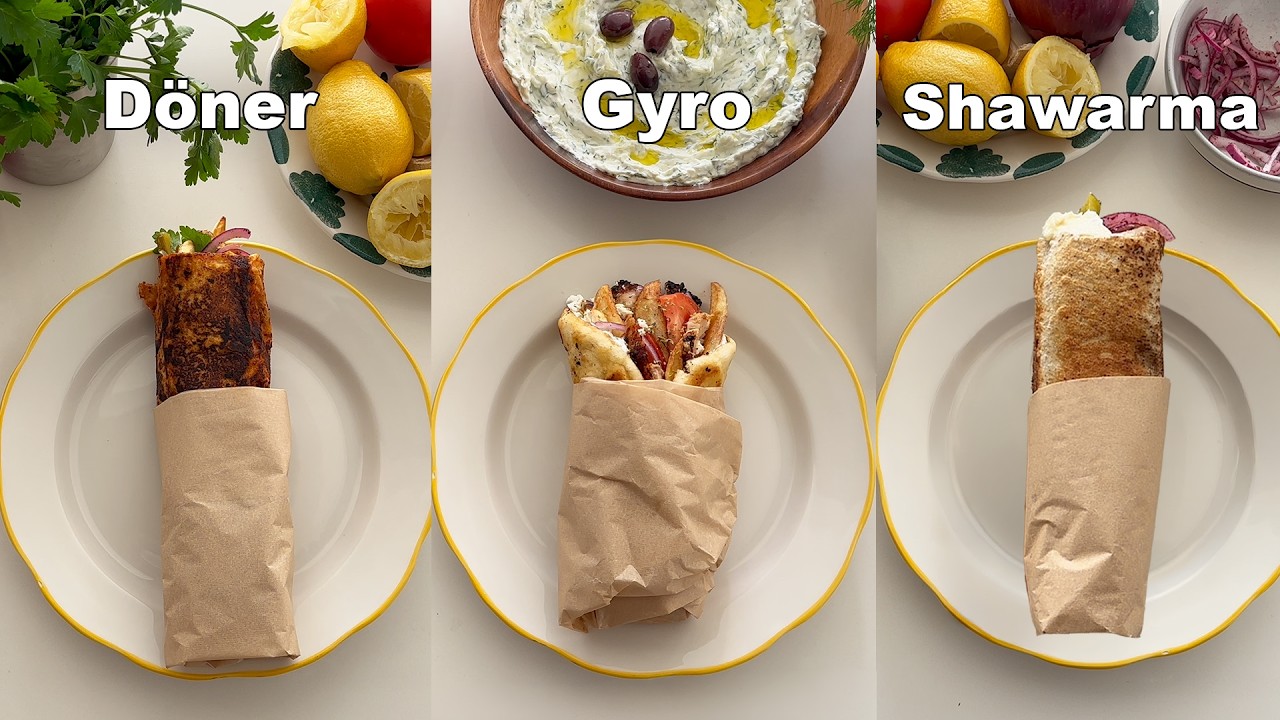
Shawarma vs gyro, doner kebab and tacos al pastor
Every one of these dishes comes off a vertical spit of stacked meat. What separates the taste is the meat, the marinade and the sauce.
| Dish | Usual meat | Seasoning and sauce | Taste |
|---|---|---|---|
| Shawarma | Chicken, lamb, beef or mixed strips | Warm spices, toum or tahini, pickles | Savory, garlicky, tangy |
| Gyro | Pork in Greece, beef and lamb in the US | Tzatziki, tomato, onion | Cool, creamy, mild |
| Doner kebab | Beef, lamb or chicken, never pork in Turkey | Seasoned meat, tomato, onion, pickled cabbage or cucumber, chili | Meaty, fresh, sharp |
| Tacos al pastor | Marinated pork | Achiote, chiles, pineapple, cilantro, salsa | Sweet, smoky, chile-red |
Gyro tastes cooler than shawarma because tzatziki, a yogurt and cucumber sauce, replaces garlic sauce and tahini. A separate piece on how a gyro differs from shawarma covers the two sandwiches side by side.
Doner kebab is the Turkish original. Turkish stands top it with tomato, onion, pickled cabbage or cucumber and chili on Turkish bread (SBS Food).
Chicken doner is the cheapest and most common version in Turkey, and pork doner does not exist there, according to Yummy Istanbul.
Sources split on whether the spit meat is minced. SBS Food says doner meat is often highly seasoned and sometimes minced, while shawarma stacks use strips of meat and fat. MEL Magazine says gyro is ground meat roasted on a similar spit.
Wikipedia’s gyros entry says Greece normally uses pork and dates the first American mass production to the early 1970s in the Chicago area. The National Herald reports that a 1969 Chicago Tribune columnist compared the cone to a round meat cake resembling meatloaf.
That points to the formed American cone as the source of the ground-meat claim, which is why a US gyro tastes more uniform than a shawarma plate.
Tacos al pastor descend from shawarma, though the sources date them differently. Tasting Table places the origin in 1930s Puebla, where Lebanese immigrants sold lamb on flour tortillas or pita as tacos arabes.
Mexico News Daily says the pork version took shape in Mexico City and settled into its current form by the 1960s. It credits the dish’s popularity to a mild taste before salsa goes on.
Pineapple on the spit adds the sweetness. Chef Alex Stupak of Empellon Al Pastor says nobody knows where that habit started.
What should a first-timer order?

Order a chicken shawarma wrap with garlic sauce and pickles. Chicken is the mildest meat, and that sauce and pickle pairing is the usual default for it at Middle Eastern stands.
Start with the meat. Chicken is mild, lamb is rich, and a mixed stack lets you compare both. Then pick one sauce: toum for garlic, tahini for nutty or amba for sour. Add pickles. Decide on heat after that, and last of all whether you want a wrap, a plate or a sandwich.
Heat comes late on purpose. Kremezi calls zhug usually very hot and advises starting with a small amount.
A wrap puts meat, sauce and pickles in one bite. A plate serves the meat with rice or salad and the sauces on the side, which makes it the easiest way to taste each part alone.
If you already know what you like, the shortcuts are simple. For mild, go chicken with tahini and no hot sauce. For rich, lamb or a mixed stack with tahini and pickles. Sharp and sour means amba and extra pickles on any meat, and anyone chasing heat can take any meat with a thin line of zhug.
Why does some shawarma taste dry, flat or greasy?
Dry shawarma comes from meat that sat too long after carving. Flat shawarma comes from weak seasoning, and greasy shawarma from a stack with too much fat.
Carved meat parked on a warm tray loses its crisp edge and its juice. The FDA Food Code sets 135 degrees F as the minimum for hot holding (Institute of Child Nutrition fact sheet), which protects safety, not texture.
A thin marinade or tired spices leave the meat tasting of salt and little else, so the sauce has to carry everything. Fat added to the stack for juiciness turns oily when the ratio runs high, and the drippings pool in the wrap.
Chewy shawarma is a slicing problem. Thick shavings lose the tender-and-crisp contrast that thin ones give.
When you’re sizing up a stand, look for meat carved to order from a browned stack rather than scooped from a tray. Several spits turning at once is a turnover signal, according to the food blog An Edible Mosaic. Cones stacked fresh by hand each day are another, as Hello Shawarma in Bridgeview, Illinois does, per NBC Chicago.
ThermoWorks’ home vertical-spit recipe shows what careful carving looks like. It slices about 1/2 inch in from the edge and rotates the spit after each cut, so every portion comes from the browned surface.
A dry or greasy shawarma is usually a problem with the stand, not the dish.
Shawarma FAQ
Is shawarma good?
Yes, if you like savory, garlicky, spiced meat with a sour finish.
Chicken with toum and pickles is the safest first order, and a stack carved to order matters more than the meat you pick.
What is in shawarma?
Spiced meat shaved from a vertical spit goes into a flatbread such as pita, laffa or lavash, along with toppings.
Those toppings are usually sauce, pickles, tomato, cucumber and onion. Some wraps also carry fries.
What goes well with shawarma?

Hummus, fattoush, a cucumber and tomato salad, rice and pickled vegetables all pair well.
A cold drink such as lemonade cuts through the garlic and the fat.
Does vegetarian shawarma taste the same?
Not quite. Cauliflower, mushrooms and seitan take the same cumin, coriander and paprika marinade and taste spiced and savory.
They lack the rendered fat and char of spit-roasted meat, so the sauce does more of the work.
Which Shawarma to Try Next
Change one thing per order and go meat first, sauce second, regional style third. One change shows what it contributes, and two at once hide it.
Swap chicken for lamb or a mixed stack, then swap toum for tahini and later amba, then move from Lebanese to Syrian, Egyptian or Israeli.
The trade-off is mildness. Each step up in intensity makes the spice blend harder to taste under lamb fat, fermented mango or chile.
This order holds as of October 2026 and fails at a stand with slow turnover, because stale meat dulls every variable.
For regular orders, the next question is whether shawarma is healthy.


